
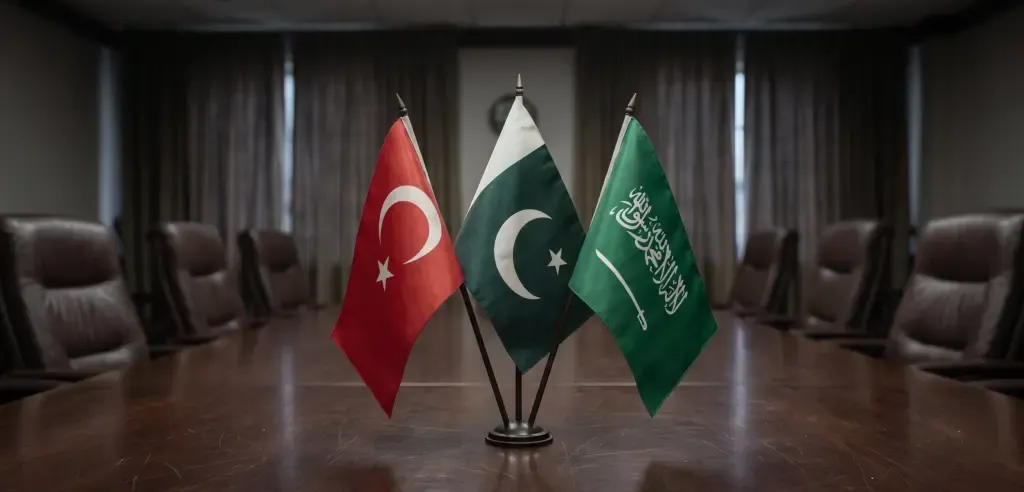
Recently, Turkey, Pakistan, and Saudi Arabia signed a mutual defense pact, declaring that an attack against one is an attack against all.
For readers here in Kentucky, a Middle Eastern defense alliance might seem worlds away. But this historic move signals a massive shift that directly impacts US prestige as a world power: key global players increasingly view US security guarantees as unreliable.
A mutual defense pact is a military alliance where nations promise to protect one another from outside aggression. By publicly standing together, these three countries are attempting to deter a shared enemy—Iran—by proving they will fight as a unified front.
What makes the Mecca pact unique is its high level of commitment through an automatic defense clause. It unites three critical US allies that historically have not gotten along: Turkey (a NATO member), Pakistan (a nuclear-armed power), and Saudi Arabia (a wealthy Gulf nation). Further, each has ties with the other's historic adversaries.
For example, Saudi Arabia and India have become more aligned over the past decade, while tensions over Kashmir continue to roil relations between India and Pakistan. Under the Mecca pact, an Indian attack on Pakistan theoretically would trigger action from Saudi Arabia.
Yet, fear of Iran, paired with fading trust in Washington's promises and its lack of progress in its war against Iran, has forced these unlikely partners to the negotiating table.
For now, this alliance is primarily a political statement. It lacks the deep operational backbone that makes NATO effective, such as centralized command systems and decades of joint military training.
While the US may have quietly encouraged this accord in order to reduce our own heavy military footprint in the region, the long-term implications are troubling. For decades, global stability has relied on the strength of US promises. When US allies feel forced to form their own nuclear-adjacent military blocs, it signals a tangible decline in US prestige—prestige being the ultimate coin of the realm in international politics.
As Kentuckians watch federal spending debates and wave goodbye to service members deploying from Fort Campbell or Fort Knox, global shifts like the Mecca Accord matter. They remind us that when the US steps back on the world stage, the vacuum is quickly filled—leaving the US with less influence over the global events that inevitably hit home.
José E. Mora, PhD, is a former Professor and Chair of Global Affairs of the American University of Phnom Penh in Cambodia. Mora and his wife, Melissa, recently moved to Berea in order to be closer to their four adult children.
Sign up for The Edge, our free email newsletter.
Get the latest stories right in your inbox.