
'Richmond's poor infrastructure discriminates against everyone'
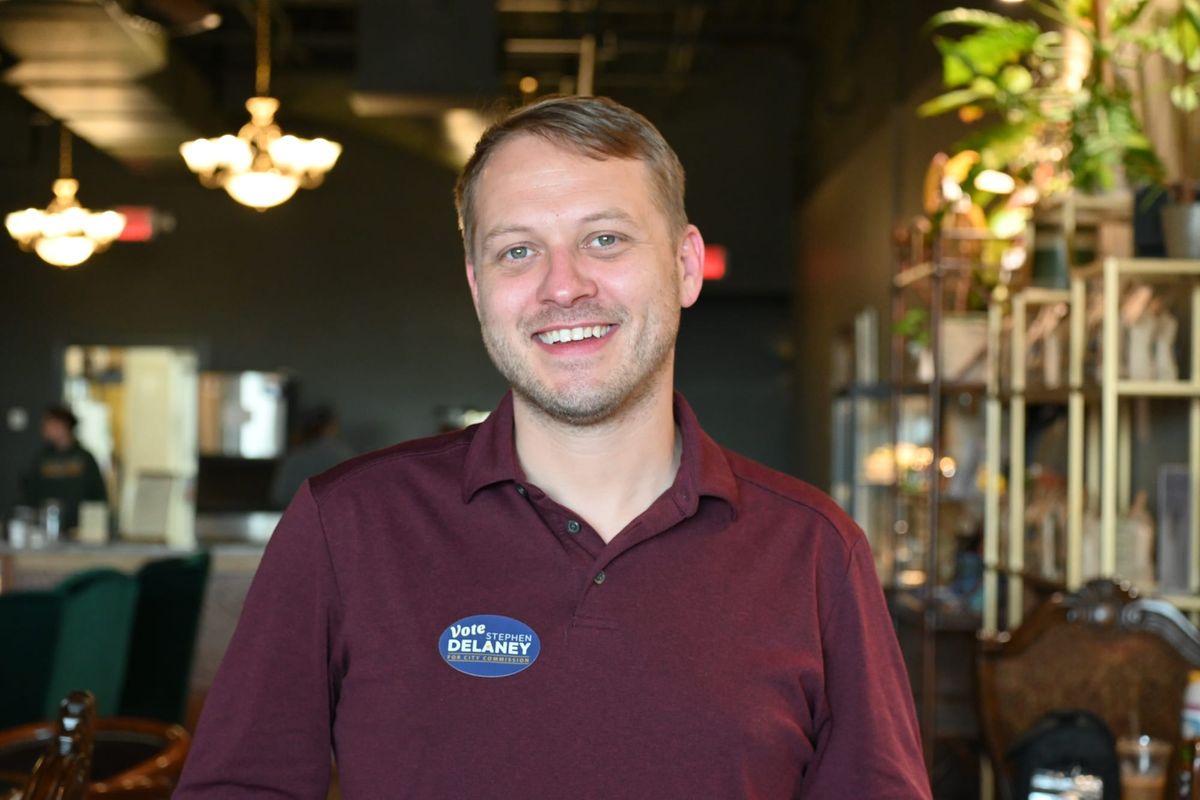
Candidate Stephen Delaneys says his plan for accessibility would improve quality-of-life for all residents, not just those with disabilities
Greetings,
This election season we've invited all Richmond City Commission candidates and both mayoral candidates to either submit a letter to the editor detailing their platform for office, or to sit for an interview with our Richmond City beat reporter, Jemi Chew.
This interview is with Commissioner candidate, Stephen Delaney. We've edited the interview for length and clarity.
All opinions and claims made by Delaney are solely his and do not necessarily represent the views of any person at The Edge.
Thanks to the three candidates who have responded to our invitation. To date, not a single incumbent has acknowledged, much less accepted our invitation to share their platform with The Edge.
For more election coverage, visit our Election 2026 coverage channel.
---------------------
Since The Edge first began publishing on October 24, 2024, we have steadily grown to where we now reach a third of the county on average each month.
We could not have been this successful without your loyal support. Thanks to you, our growing Richmond readership, and to our loyal readers and subscribers who have been with us since we started.
If you are an advertiser who'd like to reach our audience, please use the pink button below to contact us.
Thank you for reading The Edge.
Whitney McKnight,
Founder & Publisher,The Edge
The Edge: Hello Stephen Delaney, thank you for agreeing to be interviewed. First, some background for our readers. You currently work as an American sign language interpreter and run a pet grooming business in Richmond. This is the first time you are running as a candidate for office. Why have you decided to do this?
Stephen Delaney: I would say my faith is the reason. I feel called to help other people. In my professional work as a sign language interpreter, I'm often in rooms where people are crying because they don't know how they're going to afford their next meal. So that work is constantly reminding me that there are people in Richmond who need our help and protection.
I don't think there's another person in the race that is constantly exposed to situations like that, exposed to situations and people that are not like them, and where you're constantly having to be their voice. Loving your neighbor and all of that, it's more than just being the nice thing to do—the impacts of it are in my face.
The impact that our local government has is huge and immediate. Something needs to be done, it gets put in [the agenda], and before our constituents can speak out against something, it's already been passed.
I attended college in Washington, D.C. and got a bachelor’s degree in sign language interpretation and a master’s in healthcare interpretation. Then I opened a business in Richmond. I finally feel that I'm at a point where I could do this and have some credibility.
The motto I live by is the squeaky wheel gets the grease. Because when things are fine, no one pays attention, but as soon as there's an issue, that gets all of your attention. So if there's an issue and I'm your City Commissioner, I will be the loudest person in the room until it gets solved, I can promise that.
TE: Circling back to what you said earlier, can you give an example of a decision that was passed quickly without much discussion?
SD: The City got a lot of federal funding during covid, from the American Rescue Plan Act, or ARPA. Richmond spent $193,000 for vehicle barriers, $613,000 for police cruisers and accessories, and $358,900 for an armored vehicle and approximately $900,000 on a police mobile command unit I've seen used a couple of times for parades or fireworks for July Fourth. Public safety is a top priority so I'm not saying defund the police, no.
But to the best of my understanding, other cities took the same money and then invested that in things like medical debt relief for their citizens. Lexington just did that. They took a certain amount of money, gave it to a company, and forgave millions of dollars [of debt] for Lexington residents.
That is something that could change people's lives. It could save them from bankruptcy, save them from foreclosure. And that's at the city level. That is something that I could be in the room where it happens, saying, "Hey, well, what about this?"
TE: If you are elected, what are some other issues you would like to give voice to?
SD: There are a lot of things with our local deaf community that I would like to accomplish. Eastern Kentucky University has, I believe, one of 12 accredited sign language interpreting programs in the country. And that attracts a large number of deaf professors and deaf students.
Having a closed caption ordinance would be revolutionary for the lives of deaf and hard of hearing people, but also veterans, seniors, and immigrants. Things that are building accessibility into our City don't just benefit people with disabilities, it benefits everyone.
Our sidewalks on Main Street are so uneven. I saw someone trying to get their motorized wheelchair up there, and it made me angry. And that's not just the person with disabilities, it's also the mom with the stroller. There are so many different people that would benefit if our City had the most basic infrastructure, if the most basic things were prioritized. Accessibility and infrastructure, those two things go hand in hand.
TE: So that leads to my next question, what are the main issues facing Richmond? What needs to be prioritized?
SD: There are so many problems with our infrastructure. Infrastructure should be the Commissioners' sole focus. Our traffic planning is terrible here. I understand it's a state issue, there are county roads, there's the Interstate, but there are people in Frankfort whose job is to communicate with the local officials, to explain what's happening, and for us to communicate about what our needs are, and I don't think that's being done.
There are hundreds of stop signs in Richmond that don't have the line that tells the car where to stop, which may not be required by the state. But if we have all these new drivers coming through here, they're in an unfamiliar territory and they're rolling through stop signs and I’m really concerned that someone's going to get hit.
With our EKU population, our student population, and with inflation and the number of e-bikes we have, we need to have a bike lane.
TE: It sounds like you're saying that is a quality of life issue.
SD: If people who live here have access to jobs, grocery stores, bike lanes, you know, an easier life, people would naturally be attracted to Richmond. Then the diversity of new people coming in, bringing their talents, their skills, their history, is going to benefit the community.
The stronger workforce we have, the more other businesses will want to come here and open their factories, open their operations.
I would also advocate for some leash laws and more support for animal control because we're having dogs and animals everywhere, and the poor dogs, I feel so bad for them.
TE: And so how do you feel about the growth that is facing Richmond?
SD: I am definitely not anti-growth, I would say that I'm anti-endless sprawl with no plan. I’m against taking someone's property like Scott Gabbard's farm to put in a new road for the airport. We are told that it is a state issue and there's not much that we could do about it, but I would try.
We have so many new people coming here and I want other people to enjoy it, but we’ve got to make some changes for that to be sustainable with our current growth. The infrastructure is just not there. The infrastructure can’t handle it.
There's a long history of cattle farmers here in Madison County. The Madison County Stockyards make a lot of money for the City. Some of the farms that people are running and raising cattle on, that's their dad's farm. It was their grandfather's farm. It was their great grandfather's farm.
So this isn't just when the City wants to expand and put a new gas station somewhere. It's not just taking some land on a map, that's someone's farm. It's our culture, it's our heritage, here in this area.
Near the stockyards the roads are terrible. And if you are a cattle farmer, you have to haul a big trailer full of cows. It's not easy to get through there and there are potholes. We should be making it easier for our cattle farmers to come to our City, to do business, to make money for our City, for our people here.
As a City Commissioner, I will prioritize cattle farms over data farms, over server farms, and I would advocate that no data centers, especially hyperscale data centers, come to the City of Richmond. We need sidewalks before we need data centers. We need a Chuck E. Cheese or a fun family thing, like Dave and Buster's, something that's going to have jobs and a place where people can go and hang out, a safe place for teenagers to hang out.
TE: I believe you are one of the only Richmond candidates putting a large emphasis on preserving cattle farms.
SD: My stepdad is a cattle farmer who came down to the stockyards here, sold cattle here. I'm from Winchester originally. I grew up there, but I've been coming to Richmond my whole life because of that.
Being from Winchester is not something that I'm putting out there in the forefront of my campaign because there's a lot of pushback against newer people in the City. It's like if you're not from here, your family's not from here, then your voice doesn't matter. But it does.
I am not an outsider. I think that there may be other folks who would describe me as one simply based on the fact that I didn't grow up here. I didn't attend school here. But I am a Kentuckian, I'm a central Kentuckian. I've lived in Lexington, Jessamine County, Versailles, Georgetown, I am from this area. And having seen a little bit of all of those towns, I decided Richmond was the best one. Richmond had the best opportunities. Richmond had the best quality of life that's not too hectic, that's a nice place to live.
TE: And so why do you believe that citizens should vote for you in the upcoming election?
SD: We've got [Brewer] sitting in the City Commission who's been in there for, I think, nine terms, 18 years, and we still don't have sidewalks, we don't have a bike lane, we don't have pedestrian safety. And it's an older crowd, right? There is no one on the Commission that has a younger voice.
It's not as easy as some of our current Commissioners may think it is for people to get ahead. I, like so many other people, have student loan debt. I'm struggling to get ahead in life because it's not the same as it was back in the day. So keeping things like that in mind.
Our poverty rate is 19% in the City of Richmond [based on US census data]. It's way above our national average or state average, but our City is just plowing along without providing resources or opportunities for those people.
I'm trilingual in English, Spanish, and ASL. I can go right now and have a conversation in Spanish with someone and figure out what immigrants are facing in our city. I don't see any of the other candidates or incumbents prioritizing our senior citizens, our disabled communities, they're not prioritizing any of the marginalized groups that I feel should be protected.
I also don't think any of our current officials have an official page where they're talking about the issues that are affecting the City, where they're reporting what they've done that week, what they're doing, what's happening. I would commit to doing that.
I definitely know that this is an uphill climb for me. I'm going up against four incumbents, a previous City Commissioner (Ed McDaniel), someone who's worked in the government or the local government for the last couple of years (Mike Edwards), and then someone else. So I get it's a long shot, but we need change.
TE: Any other parting thoughts?
SD: I would absolutely vote Flock Cameras out of this City. As we're seeing every day now, a new story comes out, someone has been wrongfully charged based on incorrect data from a Flock camera. I don't think the lack of cameras is the issue in the City because there's cameras everywhere. I'm not anti-cameras, but it's a private company using AI to catch people. And we don't want computers making those decisions.
And my big push is on civic education. In this race, you do not have to vote for four people, the ballot says up to four. Only pick the people that you would like to see in there. Don’t just pick names based on gender or that you think, oh they’ll be good. Do a little bit of research, only vote for the people you want to but make sure you vote Delaney.
Sign up for The Edge, our free email newsletter.
Get the latest stories right in your inbox.


