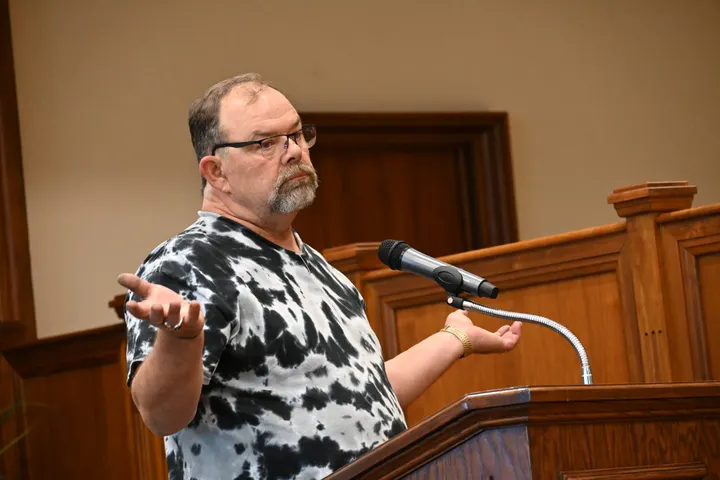
Edwards: City Commission is unproductive, anti-public
Candidate asks voters to 'reset' Richmond by electing proactive leadership
Greetings,
This election season we've invited all Richmond City Commission candidates and both mayoral candidates to either submit a letter to the editor detailing their platform for office, or to sit for an interview with our Richmond City beat reporter, Jemi Chew.
Thanks to those candidates who have responded. To date, not a single incumbent has acknowledged receiving our invitation.
This interview is with Commissioner candidate, Mike Edwards. We've edited the interview for length and clarity.
All opinions and claims made by Edwards are solely his and do not necessarily represent the views of any person at The Edge.
Since we first published on October 24, 2024, we have steadily grown to where we now reach a third of the county on average each month.
We could not have been this successful without your loyal support. Thanks to you, our growing Richmond readership, and to our loyal readers and subscribers who have been with us since we started.
If you are an advertiser who'd like to reach our audience, please use the pink button below to contact us.
Thank you for reading The Edge.
Whitney McKnight,
Founder & Publisher,
The Edge
The Edge: Hello Mike Edwards, thank you for agreeing to be interviewed. First, some background for our readers. You currently serve on the Richmond Human Rights Commission, the board of Hope’s Wings, and as co-chair of the Richmond Downtown Neighborhood Association. But this is the first time you are running as a candidate for City Commissioner. Why have you decided to run for office now?
Mike Edwards: Three or four terms ago, I was thinking about running for office. And then I made a commitment to myself that once I retired completely from working, which I did in 2020, I would run. However, my spouse got lung cancer so that set things back.
I've been trying to work with the City for many years. And now I've decided the timing is right, now is the proper time, and we need a change.
TE: What kind of change do you want to see?
ME: I would like to see the Commission meetings full of interested residents with positive exchanges of ideas between the Commission, the mayor, and the residents without the fear of being told to sit down or of being reprimanded.
I would like to see more green space, a vibrant downtown, as well as initiatives and incentives to get more businesses downtown. We need some smart ideas to improve traffic control, traffic flow. We can't assume that everything will fall into place.
People understand their civic duties. Schools are working with the City. I'd like to see historical buildings not being torn down but being restored and revitalized, more community activities, cleanliness in the streets. There's so much that we can do. It can't be done overnight, but it can't be ignored.
Richmond is a conglomeration of all types of people and I think the underprivileged residents of Richmond are being ignored. Take for instance, the beautiful sports park that we're getting. That's great for people that can afford to get to the park. Not so great for the people that can barely make ends meet and barely put food on their table. So I want to be a part of the bigger picture in making major decisions that are directing the City to assist all of the population of Richmond.
I also believe in term limits. The current Commissioners all have a total of 40 years in office collectively. Voters can ask themselves, what have they seen progress in Richmond that supports those 40 years?
If voters want to see positive change, they should at least give me a chance. Otherwise we're going to get the same results we're already getting.
My personal observation is that for the City's elected officials, it's just a job [to them]. It shouldn't be a job. This should be our mission. This should be our passion. Making Richmond better should be our passion. But I want to make sure that the incumbents know that I'm not running against them, I'm running with them. And I want to work with them, but I want to work in a better way.
TE: What are some areas you think should be improved?
ME: The leadership in Richmond needs new ideas on dealing with homelessness, on dealing with infrastructure, on dealing with how to enforce property codes and ordinances, how to deal with government housing, and how to deal with housing in general, such as with tenant and landlord regulations.
I also think the City needs to adopt a fairness ordinance to support all residents of Richmond. The City has turned down any push for a fairness ordinance in the past. They've said that there is no need for one.
Just because LGBTQ+ violations are not being reported, doesn't mean they haven't existed. I have first hand proof regarding how Richmond Pride was discriminated against. I brought it to the attention of City leadership and nothing was done. (Ed. note: The Edge was unable to verify this claim by publication time.)
A city such as Richmond needs to demonstrate that all people are welcome, safe and respected if they choose to live here.
Also, I think the Commissioners need to be more inviting to residents during meetings and to allow residents to voice their opinions, whether they are negative or positive, without lashing out at them. I think all the elected officials need to collectively work together, stay away from the inside fighting, the name-calling, the finger-pointing, and collectively remind themselves why they have been elected to the positions that they hold.
TE: Let's circle back to something you said earlier about the public being "reprimanded". It sounds like you think the public is being discouraged from voicing their opinions.
ME: The Commissioners are afraid of hearing something negative. If it's something the Commission or the mayor doesn't want to hear, they say, 'Sit down Sir.' They don't want to hear it.
You can't keep on shutting your public down. You kick a dog one too many times, it's not going to get back up. And that's how a lot of the people in Richmond feel. But they've settled for it. I don't want people to settle for what they’ve got because we can do better.
TE: What if these voters, who you say have “settled,” believe that what you hope to achieve as Commissioner is impossible?
ME: Nothing's impossible. It won't happen overnight, but we need to reset Richmond. And we need to start working on the mindset. People have a voice. Just because they don't think they're being heard, they still have a voice. They have someone in me that will listen to them. I absolutely do not believe in the status quo– the idea that we do it 'this way' because we've always done it this way. No, we're gonna change and do it the right way. The better way. I promise we'll deliver different results.
The majority of the time, my glass is half full. I'm a very positive person and I look for the best in all people. I am very persistent and I don't like the word no. And I take great pride in raising people up, making people successful. I'm not afraid to try something, I'm not afraid of failure. I've failed many times. But at the end of the day, I won't give up. And I'm here for all, daily. I can be very creative in my approach to building a successful community but I can't do it alone.
The mindset of the City has to change. The City Manager, and all the departments within the city, should have the same level of respect and responsibility for the community.
If they see an issue that needs to be fixed, they need to report it to the appropriate people and fix it. They don't need to wait until it becomes a disaster.
TE: Can you cite an example of what you're talking about?
ME: It amazes me to see how dilapidated several of the neighborhoods are throughout Richmond because of non-enforceable codes and ordinances. I have brought this to the attention of Commissioners in the past. And one response that I have received is, 'It's so out of control that we don't know where to begin.'
We need to collectively come up with an idea to address the situation. Ignoring it and just throwing your hands up in the air and saying we don't know where to begin, there's nobody else in the City that will fix it.
This is a simple issue that has been allowed to become a major issue because of no action.
TE: What if the “mindset” you previously mentioned doesn’t change?
ME: My 24 years in the military—I did a year at Penn State University before enlisting in the Marine Corps at the age of 19 and retiring in 2001 from Camp Lejeune, North Carolina, with the rank of major—have allowed me to work with all kinds of personalities, all kinds of egos, and all levels of narcissism.
Making decisions for the right reasons, holding others accountable, and questioning the reasons why the Commissioners may vote for or against a certain situation will be my approach.
When someone votes yes or no on a particular issue, I want to know why. I want to know the motive behind it. Doing what is best for the community and not for any one individual will be what motivates me to bring positive growth for the City.
TE: Speaking of which, growth has become a hot topic this election cycle. What are your views on this issue?
ME: I believe in growth in the right areas but we need to make sure that we are not growing a cancerous cell on one side of the body and then ignoring it. It won't go away.
We need growth to get people out of poverty because growth in the right direction will create good paying jobs. But we need to have the infrastructure, the roadways, and the traffic lights. We need to address all this stuff before we make rash decisions to build cookie cutter homes on hillsides that are gonna cause flooding.
We just need to do a better job. I think Richmond needs to work with the county, needs to work with surrounding counties, needs to work with the city of Berea, probably the city of Winchester, Nicholasville, and all these other communities of similar size to ours and find out what's working for them, what's not working for them, and compare notes and grow together.
I feel like Richmond just wants to be so isolated and take credit for all the good things they're doing and not take responsibility for all the things that may be going badly.
I've lived in several communities throughout the country where growth is good, but the communities grow together and the less fortunate people are not left behind. Over 19% of Richmond lives below the poverty level. That’s not growth. We're leaving a good portion of the population in Richmond behind and ignored. We can't continue, that's not the American way. That's not the Christian way.
TE: Any other parting thoughts?
ME: I’ve never lived in a place this long. I was born and raised in Bloomsburg, Pennsylvania. I've lived on both coasts and in the middle of the Mojave Desert. I've lived in Japan. I've served in Korea. I did a deployment to Somalia in support of Operation Restore Hope. After retiring, I got a job offer in Lexington and bought a house in Richmond, that's been almost 25 years now.
Richmond is my home. I have a deep respect for Richmond, but I don't think Richmond is living up to its complete potential. I've never been the type of person to sit back. I want to be involved, I want to make an impact. It's not that I want to, it's because I have to.
Sign up for The Edge, our free email newsletter.
Get the latest stories right in your inbox.