The pros and cons of school-based law enforcement
The Edge investigates the growing regional trend
In 2018, Gabe Parker, then 15 years old, killed two students and injured 17 others with a hand gun at Marshall County High School in Benton, Ky., changing the conversation about school safety in the state.
“We [once] had the doors wide open," Madison County Schools Superintendent Randy Neeley told The Edge in an interview. "When you came into the school building you could come right into the hallway and we welcomed that. But now the times have changed.”
Violence is not a chief feature of MCS schools. The most notable incidents requiring a law enforcement response last school year both occurred in April when an anonymous caller claimed to have placed a bomb at Madison Central, prompting an evacuation and a sweep of the premises, and when a fatal armed robbery at a Berea bank sent Madison Southern and Foley Middle School into lockdown.
"The one thing that keeps me up, that I worry about each and every day, is school safety, because a lot of times it’s out of our hands,” Neeley said.
While this might be true anecdotally, robust national data sets in support of school-based law enforcement are hard to find. Since MCS is the latest of several school districts across the region to form an in-house law enforcement agency, The Edge spoke with Neeley and other area school superintendents to learn the thinking—and the associated costs—behind their decisions.
School violence trends
Covid complicated data collection on school crime, but a 2024 federal report showed that across more than 86,000 US public schools in 2021-2022—the first full school year post-pandemic—crime was trending downward with 15.6 incidents per 1,000 students reported, compared with 24 incidents per 1,000 students in 2018. In 2008, the incidents were closer to 50 per every 1,000.
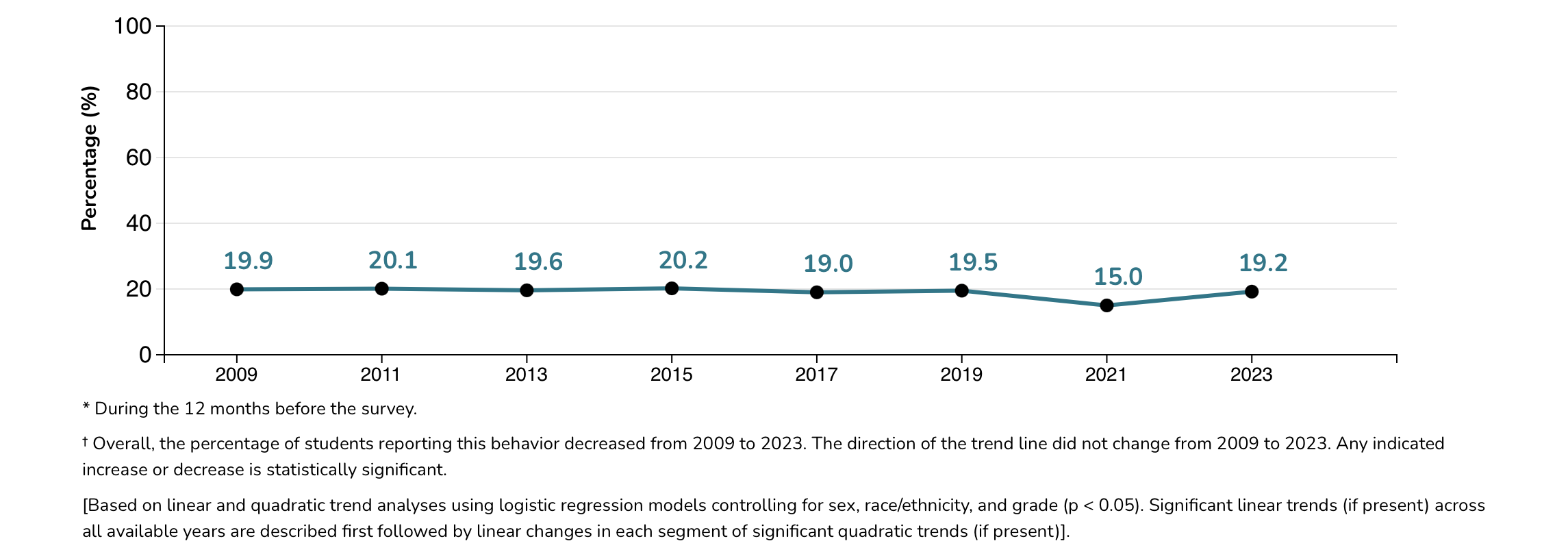
By 2023, the most recent federal data on risky youth behaviors found that bullying on school grounds had remained at a fairly consistent rate since 2009 in youth aged 12 to 18 years. Cyberbullying spiked from about 11.5% to about a quarter of all youths that age.
Even gang violence seems to have lost its appeal to teens. In 2004-2005, nearly a quarter of US students (24.1%) reported having observed some form of gang-related activity on campus. That number fell to 5.5% of students in 2021-2022.
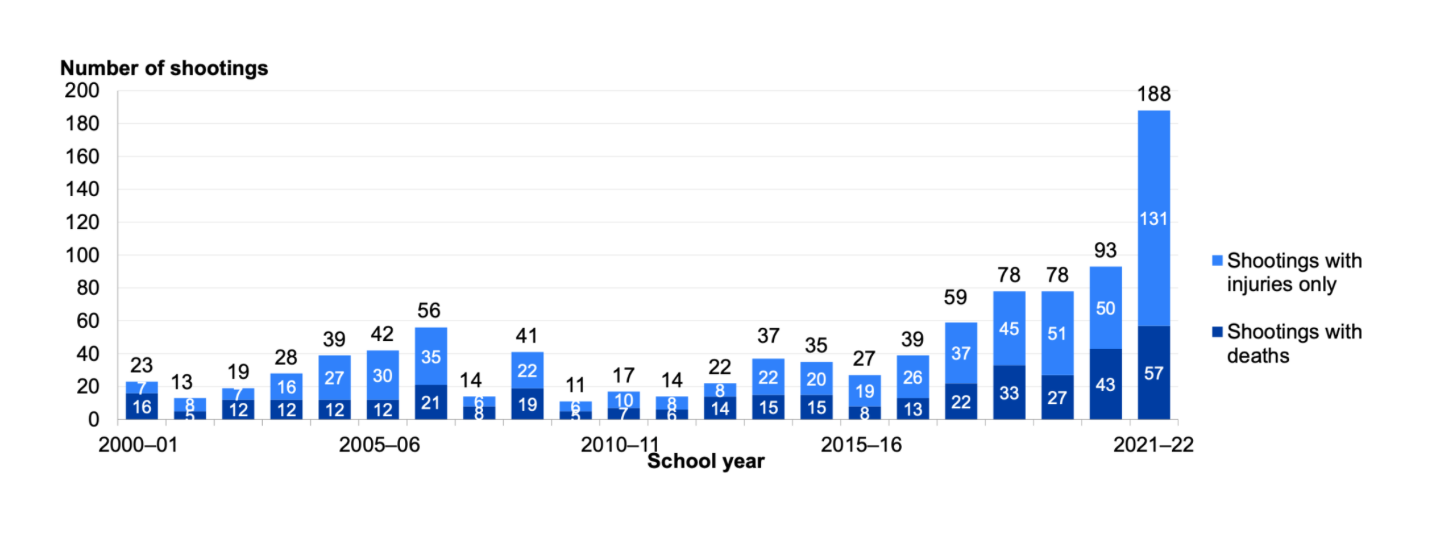
What has trended upward, however, are school shootings. In the period between 2021-2022, there were 188 firearm-related deaths or injuries at US schools, an all-time high.
Law enforcement response
After the Marshall County High School shooting in Kentucky, the General Assembly passed the School Safety and Resiliency Act mandating that every school campus in the state have at least one school resource officer assigned to it.
But national data in support of school-based law enforcement are still fairly thin.
A 2020 federal study of 33 California public middle and high schools that hired school-based law enforcement compared them with 72 public schools in the state that did not, found that across a 20 month-period, the increased police presence was not associated with a decrease in the number of recorded crimes, but was associated with an increase in the number of recorded incidents of weapon and drug related offenses.
However, the study's authors also noted it was possible that the number of crimes recorded increased because school-based law enforcement uncovered existing crimes that would not have been recorded or addressed by the school system because they previously went unnoticed.
There was also an increase in exclusionary disciplinary action by the schools with increased police presence.
"Because of this latter finding, the study recommends that schools consider security alternatives to an increased law enforcement presence in schools," the study's authors wrote.
Another federal study of California public schools by different authors, published earlier this year, found that when school-based law enforcement officers were removed from schools, the overall effect was positive.
For this study, the authors compared 60 schools from six districts that had removed police during 2019–2021 with 120 matched comparison schools from 30 districts that retained police, tracking outcomes through the 2021–22 school year.
In schools where police had been removed, there was no increase in violence, harassment, bullying, substance use, delinquency, or suspension rates. The study also measured whether schools with higher student-to-counselor ratios and which retained police showed higher rates of student-reported violence. They found that when police were removed, the counselor-to-student ratio did not negatively impact crime rates in the schools.
"[S]chool police are not the determining factor in school safety—rather, comprehensive support systems, mental health resources, and positive school climate are essential regardless of police presence," the study authors wrote.
Still, the authors acknowledged that their conclusions may be limited due to the fact that they were only able to interview eight school staff members. Furthermore, the authors said their study focused on specific school districts in California, so the findings might not be applicable elsewhere.
“Although the interviews provide examples from the field and insights into the districts’ experiences following policy, decisions regarding school police, the findings may not be generalizable beyond these districts,” the authors wrote.

Local trends
While national data may be limited, closer to home, some school districts have responded to their perceptions of school safety trends by creating in-house police forces.
In Clark County, where 11 in-house officers began policing that district's 10 public schools in January 2023, discipline referrals decreased by 18% and out-of-school suspensions decreased by 37%, Superintendent Dustin Howard told The Edge in an email. The total population in that district is just over 5,000.
“This initiative has been essential to ensure that our students, staff, and school's safety are our number one priority,” Howard said.
In Pulaski County, where an in-house police force took effect in 2025, it's still too early to quantify the force's impact on school safety, according to officials there.
“Our primary goal in creating the department was to provide our stakeholders with first-class law enforcement coverage throughout the district,” Pulaski County Schools Superintendent Kent Mayfield said in an email. “Having our own department gives us greater flexibility to deploy officers where needed, provide coverage for extracurricular activities and events, and ensure that all our schools have school resource officer coverage.”
Officer Kendra Wilson, an officer at the Pulaski district, anticipates the data will show a positive effect across Pulaski County's 14 schools, serving 7,801 students.
“We have a lot of training in the legal department that actually teaches us how to be more responsive and better officers in regards to juvenile law,” Wilson told The Edge in a phone interview. “I don’t remember [ever] having nearly as much training as how they train us.”
While the School Safety and Resiliency Act requires each school to have at least one counselor dedicated to mental health counseling at least 60% of the time, Wilson said police officers are also trained to spot mental health concerns by focusing on relationship-building and getting to know the students.
“We look for changes and we try to respond to those," Wilson said. "We can deal with mental health issues. We can get the students directed to the appropriate care with counseling.”
In Madison County, which has the state's seventh largest school district, according to Neeley, the in-house force of 20 officers will patrol 11,100 students across 20 schools.
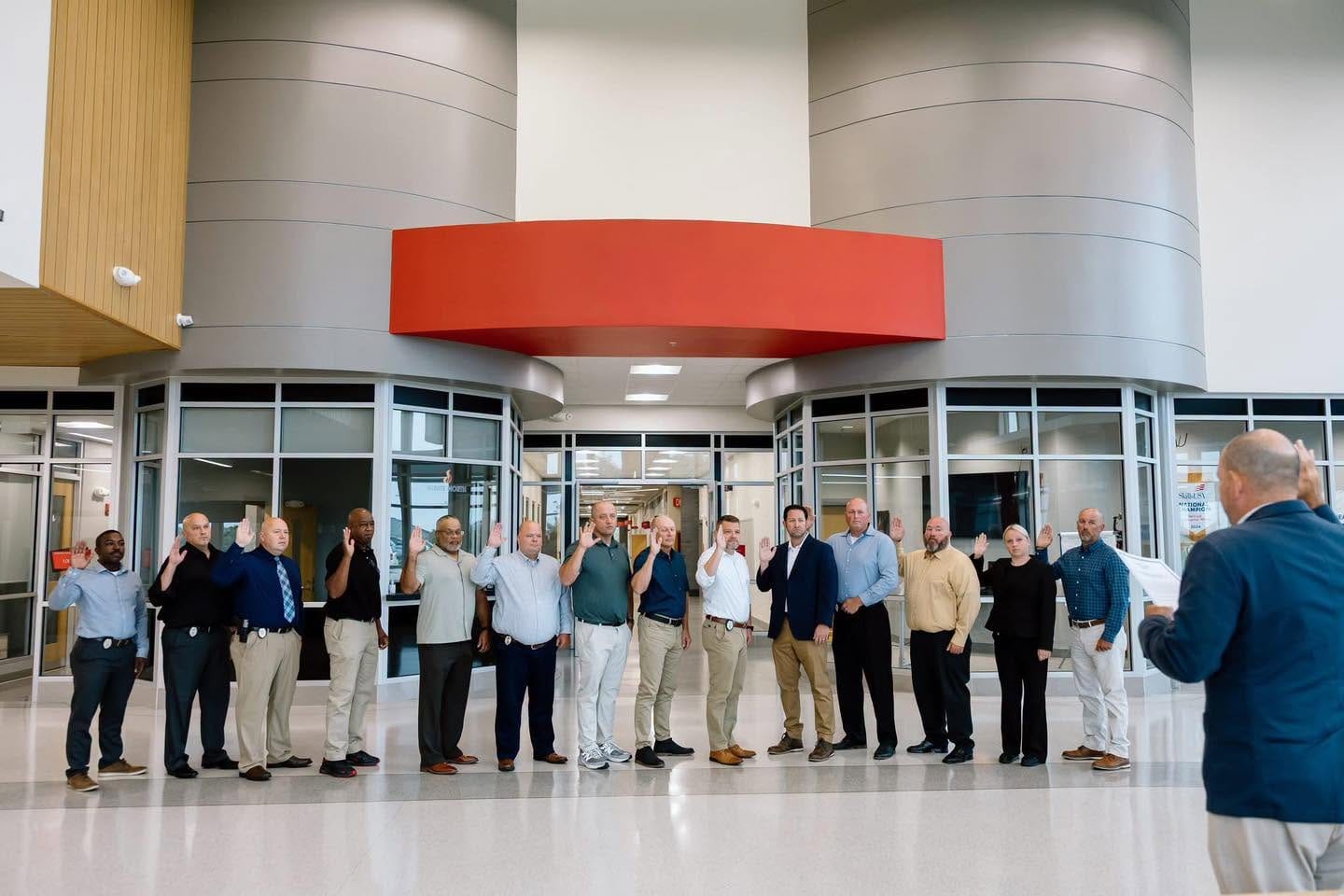
Cost of MCS in-house cops
For MCS's Neeley, the move to an in-house department was based on a cost-benefit analysis. “It came down to the fact that I can do this, have a policeman at every campus, for not too much of an increased cost," Neeley said in the interview.
Previously, Madison County Schools employed 13 safety monitors and eight school resource officers, hired in from the County's three law enforcement agencies (the Richmond and Berea police departments, and the County sheriff's office), at an annual cost of about $1.2 million.
Now, the District spent about $1.8 million to create its in-house police force, including startup costs. Nearly all of the spend is on personnel costs, about $1.6 million annually, according to Neeley. This includes salaries, benefits and insurance for the officers, as well as training. Madison County Schools Chief of Police Ben Wilcox’s annual salary is $83,540, including benefits. The other 19 officers' salaries range from $44,166 to $59,829 depending on years of experience.
No additional taxes were raised to fund the creation of the police department, according to Neeley. Instead, money will come from the District's general fund. Additionally, the District will receive $493,060 from the state. Safe Schools legislation provides $20,000 per officer while money from the Kentucky Law Enforcement Foundation Program Fund provides $4,653 per officer.
Salaries for the eight officers from the Berea and Richmond police departments, and the County sheriff’s office, used to total $718,749.14 annually.
Pensions for the new department will be paid through the Kentucky Public Pensions Authority. However, nearly half of the officers employed by the District are law enforcement retirees, meaning that their pensions are paid by their previous employer, Neeley said.
As for start-up costs, the District only spent $200,000—half of what was originally budgeted, according to Neeley. He credited Wilcox for working his connections as former Kentucky State School Security Marshal, to help save the District money on expenditures such as police cars. The District currently has a fleet of 20 vehicles, one for each officer. Four cars were donated, thanks to Wilcox's efforts, Neeley said.
“Kudos to our chief, Ben Wilcox, who has a network unlike any other around the state of Kentucky,” Neeley said. “His knowledge of policies and procedures and his network is second to none in the state of Kentucky.”
By comparison, Pulaski County spent $1 million to create its in-house police force of 15 officers, Pulaski County Schools Superintendent Kent Mayfield told The Edge in an email.
Now that Pulaski County's in-house school police force department exists, the annual cost will drop to about $800,000 according to Mayfield. The chief of police there costs $83,000 annually, while officer salaries range from $43,127 to $57,360. Previously the school district had contracts for 11 officers, totaling $545,427.14 annually, according to the Pulaski County Sheriff’s Office.
Meanwhile, Clark County spends $514,998.85 annually, according to Howard. The chief of police there makes about $60,000, while officer salaries range from $43,197 to $53,775. Neither Howard nor the Clark County Sheriff’s Office was able to confirm how much SRO contacts cost before the creation of the district police department in 2022.
Projected impact
In MCS, officers are armed with guns, tasers, and body armor but do not use Flock Safety surveillance cameras. Neeley said MCS officers' biggest priority is building trust among the student body.
“You want to build that relationship so if a kid does see or hear something then they trust that they can go talk to you,” Neeley said. “That’s our biggest ally, the kids. They see and hear everything we don’t so that’s a big deal for keeping all of our campuses safe.”
Additionally all officers are required to go through 120 hours of training through the state's Department of Criminal Justice. The training includes modules on social media, teaching and mentoring, youth mental health, diversity and bias awareness, trauma-informed action, students with special needs, and de-escalation strategies.
“We’ll have hurdles and potholes that we hit because this is our initial voyage on having our own police department, but we’ll make sure we’ll get better each and every day, and we’ll learn each and every day from what we’re experiencing,” Neeley said. “But as far as our school system and our entire county and community, I think it’s beneficial for all of us.”
Whitney McKnight contributed to this report.
Sign up for The Edge, our free email newsletter.
Get the latest stories right in your inbox.