
Company known for powering data centers unveils plan to build solar/sheep farm in County
Rep from Silicon Ranch says data center not part of project
RICHMOND—A utility-grade solar farm is planned for Madison County now that its developer has amassed enough farmland to build it.
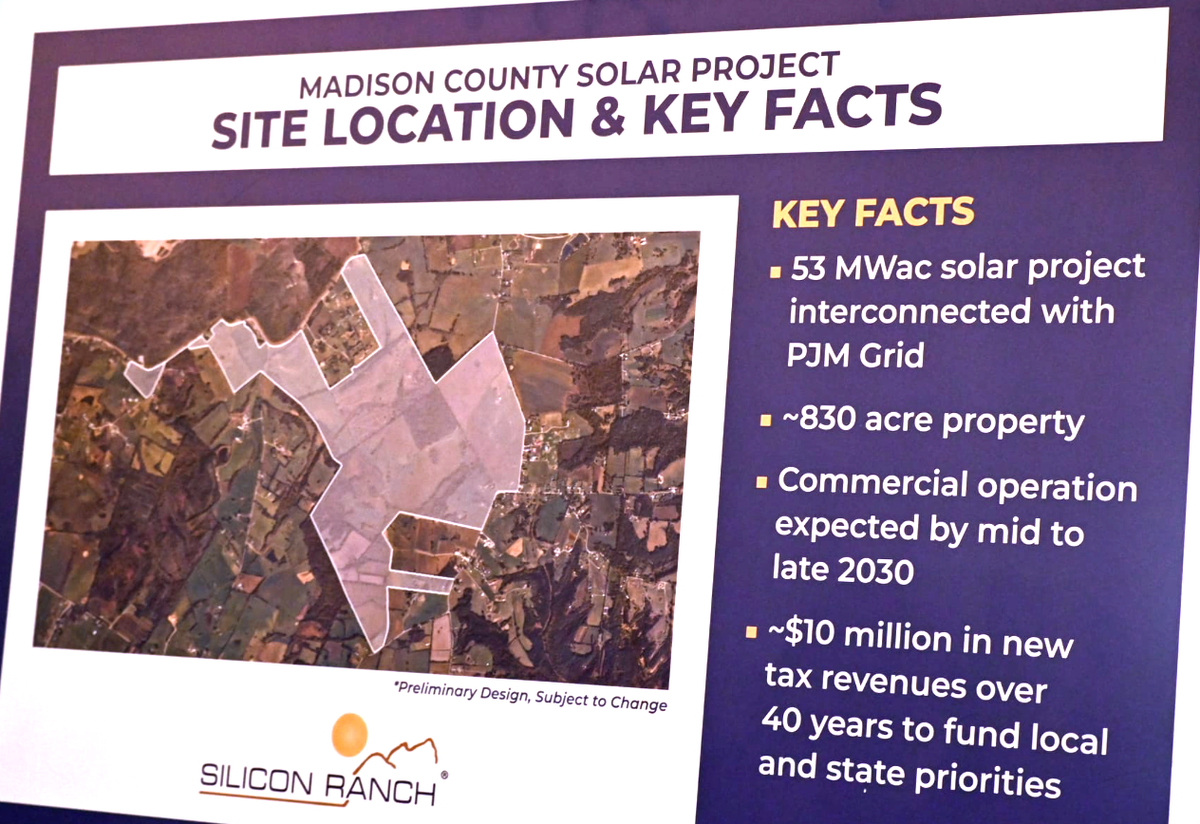
The plans were announced earlier this month during an open house at a local brewery, hosted by the Silicon Ranch Corporation, one of the nation's largest independent energy producers.
The company seeks to develop a 53-megawatt alternating current solar farm on about 830 acres—reportedly the sum total of five separate farms—off Crooksville Road, near the Miller Welch-Central Kentucky Wildlife Management Area east of Battlefield Memorial Parkway.
About half of those acres are intended as a federally mandated buffer zone around the solar panels, according to a company spokesperson.
"For the most part, neighboring landowners and residences are screened by an existing mature 40-foot-tall tree line that's 20 feet thick," Bob Corney, Silicon Ranch's head of public affairs, told The Edge in an interview. "We're not going to change that. The view they have today is the view they'll have tomorrow."
The project will not be used to power a data center, Austin Roach, a Silicon Ranch project development manager, told residents who had gathered around him during the event, expressing their concerns in raised voices and angry tones.
Neighbors of the project said they were wary of Silicon Ranch’s associations with Meta and Amazon. In 2025, the company began construction on a 100MWAC solar farm to power a Meta data center in Orangeburg, SC. In 2022, Silicon Ranch first partnered with Meta to build its 70MWAC plant in Gallatin, Tenn., outside of Nashville. Silicon Ranch's 50MWAC solar farm in Garrard County, built in 2023, is an Amazon sustainability project.
“I do not think they’re being transparent,” Annette Williams, a resident who lives near the proposed development, told The Edge after the meeting. “And I have a concern about the company being associated with Meta."
Zone change unnecessary
Silicon Ranch first began optioning land for the Madison County project in 2020, according to Corney. While the project would not require a zone change, the developer does need a conditional use permit before construction on the solar farm can begin. Corney said getting the permit would likely take less than a year, especially since, he said, the company does not expect any pushback. Conditional use permits do not require approval by the Fiscal Court.
“In many cases, if you comply with the rules that have been set by the county, then it’s more of an administrative approval, unless there’s some other feature of the project that requires additional review,” Corney said in the interview.
Environmental reviews have yet to be submitted to authorities at the local, state, and federal level, as the project is currently in the due diligence phase, when preliminary studies such as geotechnical reports are being completed, Corney told The Edge.
Pending receipt of a conditional use permit from the County Board of Adjustments, the project is expected to be completed in 2030.
Effect on local energy rate unknown
Electricity produced by the solar farm will flow into the grid and help to power homes in the area, according to Corney. Corney did not respond by press time to a follow-up email request about whether Silicon Ranch has solar power purchase agreements with area utility companies.
However, Nick Comer, a spokesperson for East Kentucky Power Cooperative, said in an email that the power coop does not have an agreement with Silicon Ranch to purchase power.
The proposed development site is next to an existing EKPC transmission substation off of Ogg Lane. The substation taps into the PJM, a regional transmission organization that coordinates the movement of electricity through the grid across 13 states in the Mid-Atlantic and Midwest. This grid connection makes the Madison County location ideal, according to Corney.
Preliminary studies show that a new substation and additional transmission infrastructure would be required for the project, according to Comer, but that the necessary upgrades would not increase energy rates for EKPC customers.
“Developers of projects that wish to interconnect with EKPC’s system must reimburse EKPC for the cost of any infrastructure upgrades necessary to accommodate the power they produce. As a result, these types of projects have no effect on the rates of EKPC’s members,” Comer wrote in the email.
Without commercial opportunities for the power generated by the solar farm, there is no point in building it, according to Corney. In addition to data center developers, Silicon Ranch sells its power generation primarily to utilities, including to electric cooperatives.
“If you cannot connect it into the transmission system or the grid, then it’s not a [viable] project," Corney said in the interview. “To install these facilities, we invest many millions of dollars in grid infrastructure that’s required by the grid operator utility, that improves the resilience of the entire grid.” Grid resilience is the ability of the electric grid to prepare, withstand, and recover from power disruptions, which are commonly caused by natural disasters.
Whether the addition of the solar farm to the grid might lower utility rates in the area is unclear. Corney said that would be determined by the utility companies. “But I can tell you we’re selling power to utilities at a much lower cost than they’re getting it in the wholesale market today,” Corney said.
Solar farms improve grid resilience because they can still produce energy even if the centralized power plant is damaged, thus helping to keep the power on, according to the US Department of Energy. Additionally, solar farms store their own energy without needing fuel deliveries to keep electricity running compared to diesel generators, which are typically used as emergency backup power.
Big Oil shareholder
Headquartered in Nashville, Silicon Ranch was cofounded in 2010 by a troika of former Tennessee state officials, including its founding chairman, Phil Bredesen, who is also a former Nashville mayor and Tennessee governor; Matt Kisber, chairman, and a former commissioner of the Tennessee Department of Economic and Community Development; and Reagan Farr, CEO and president, and the former commissioner of the state's Department of Revenue.
The privately held company hit the billion dollar valuation mark in December 2020, and with over $100 million in annual revenues, is expected to earn that much by the end of this decade. At 44%, its largest shareholder is the Netherlands-based energy giant, Dutch Royal Shell, which added Silicon Ranch to its mostly petroleum-based portfolio in 2018.
Silicon Ranch claims to be unique in the renewable energy space for several reasons, including that it purchases rather than leases the land where it builds its panels. Additionally, many solar companies sell their projects, while Silicon Ranch's strategy is to hold and manage them. Another unusual feature, according to Corney, is the company's proactive approach to community relations.
“One of the things we’re trying to do—Silicon Ranch is a little different—is to do community engagement early,” Corney said in the interview. “The issue we run into is we don’t have as much detail as a lot of people would like, especially a for a project's neighbor. We can answer [their questions] as we have more information.”
Sheep management
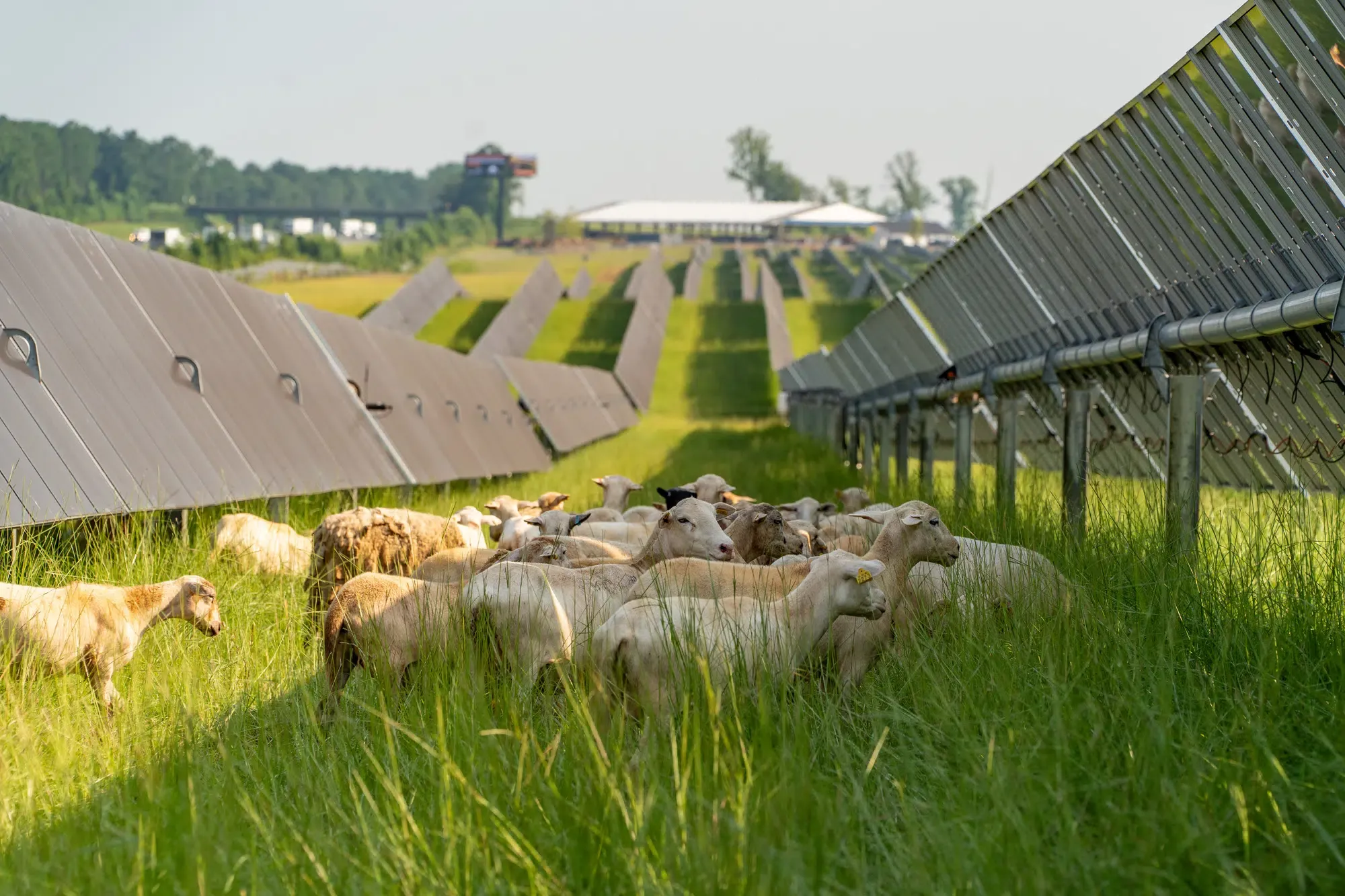
Then there are the sheep. Part of the company's policies on sustainable land practices, Silicon Ranch uses livestock to manage vegetation around the panels.
The company pre-seeds the land it develops to prevent soil erosion and to ensure that there will be good vegetation for livestock—sheep and cattle—to graze, according to Wade Archer, Silicon Ranch's senior asset development manager, who spoke with The Edge during the open house. Grazing helps keep the soil healthy, Archer said.
The company uses what is known as "mob-style grazing", an approach that involves high-intensity grazing of a pasture before rotating the herd out to another pasture. "Why we do that is because it allows for the soil and the vegetation to regenerate itself after that disturbing event from the sheep coming to graze. So that's how we keep the soil healthy."
The company also uses a hydraulic press to push the solar panels into the soil instead of the more common drilling method that relies on concrete to stabilize the panels. Thy hydraulic method is more sustainable, according to Archer.
“You can take out all the equipment and then farm it the next day because we’ve been farming it for the whole life of the project,” he said.
Who is tasked with managing the herd varies, according to Archer, who said the company typically has an open bidding process. The final decision could also depend on existing relationships with Silicon Ranch, such as the farmer who manages the sheep herd for the company's Garrard County solar farm, according to Archer.
"If we have a great vendor that comes forward and we know them, it could be a landowner, it could be somebody that we know,” Archer said. “We might not award it to them because it’s an open bidding process, but we are going to get feedback from them and look at all kinds of different prices.”
Locals voice concerns
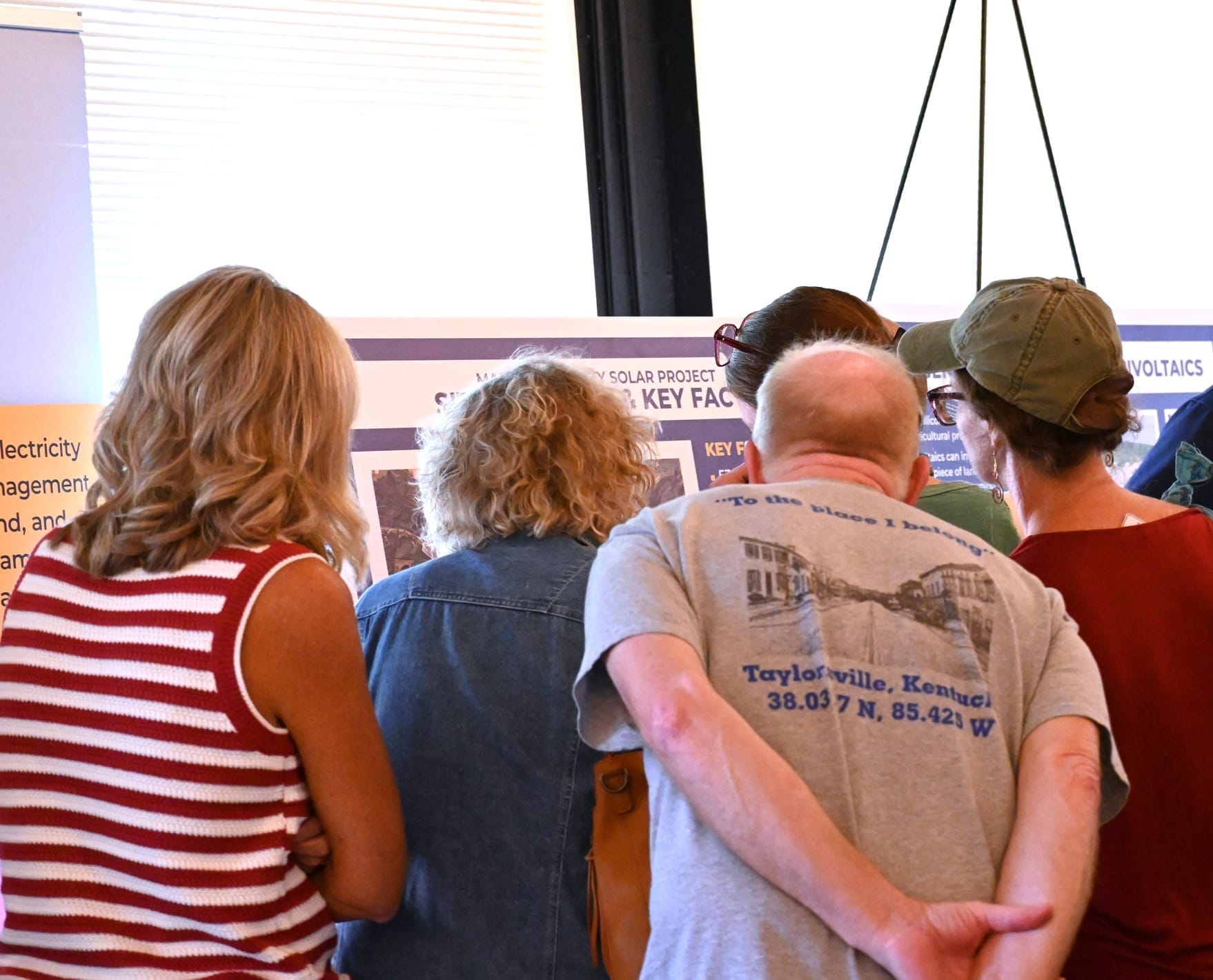
The well attended open house was hosted at the Dreaming Creek Brewery where County residents voiced their concerns about the project's potential impact on the topography and wildlife in the nearby state Wildlife Management Area.
“They are making claims without data to back up their claims,” Williams, the resident, told The Edge.
Corney and Archer both offered reassurances to residents that all federally mandated environmental studies and potential remediations are in process. Additionally, Corney said that benefits to Madison County would include $10 million in taxes over the next 40 years, plus the creation of jobs, at least temporary construction ones. Corney said the financials for his claims were unavailable at this time.
In addition to the Garrard County facility, Silicon Ranch operates a 2.5MWAC solar farm in Logan County, Kentucky.
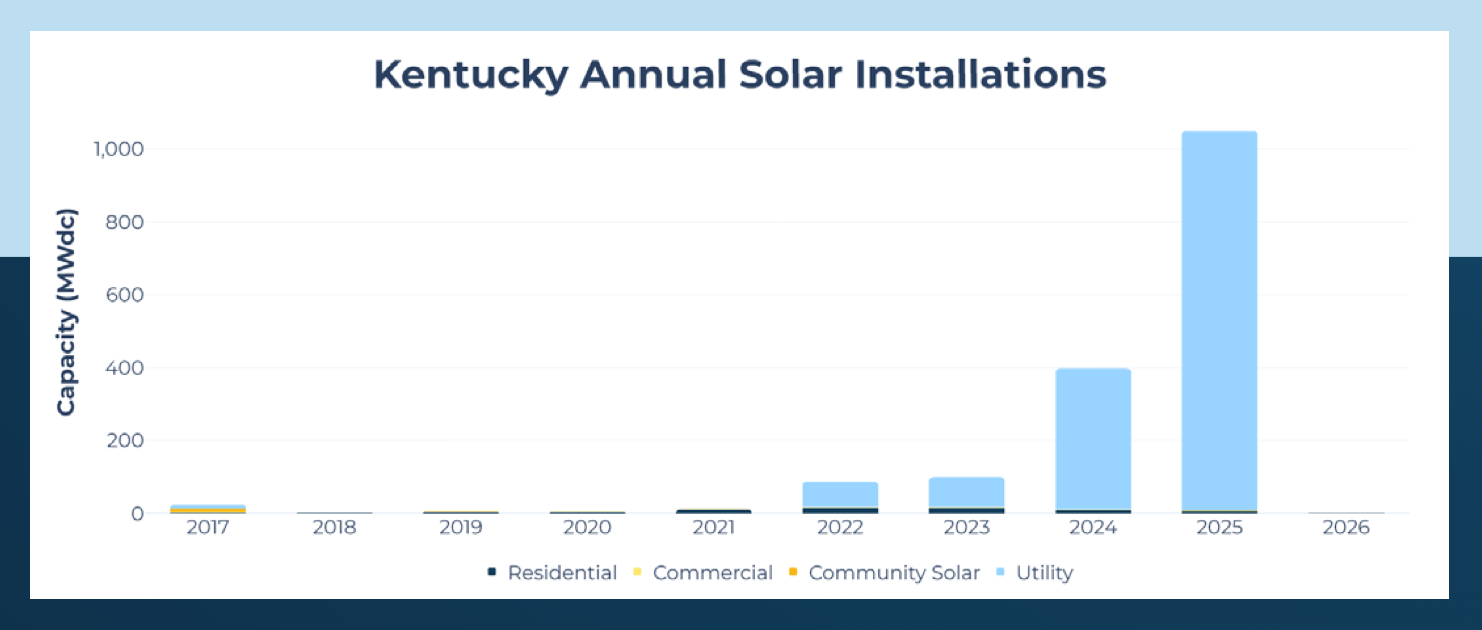
Solar power is only now coming into play in Kentucky where less than 3% of all energy produced comes from solar, according to the Solar Energy Industries Association, a national trade group based in Washington, DC. In 2020, there were virtually no solar facilities in the Commonwealth. Now, there are at least 50 solar storage and generation facilities statewide, mostly concentrated in the Louisville and Frankfort-Lexington areas.
The largest solar facility in the state helps power Toyota's Georgetown manufacturing facility. That solar farm stretches across 30 acres, and is Toyota’s largest solar project globally, producing 15 million kilowatt hours annually, enough to power the equivalent of 1,400 homes, according to Toyota.
Future public meetings about the proposed solar farm are in the works, according to Corney.
Whitney McKnight also contributed reporting to this story.
This story has been updated.
Sign up for The Edge, our free email newsletter.
Get the latest stories right in your inbox.