Botkin breaks with pro-development bloc on zone change
Plus property taxes to decrease slightly
FISCAL COURT—Although the simultaneous conversion of 1,200 county acres from agriculture to residential and industrial is now complete, one magistrate withdrew his support for at least one zone change out of six, while another magistrate challenged the timing and technical accuracy of one zone change. The discussions took place during the Court's second regularly scheduled meeting of the month.
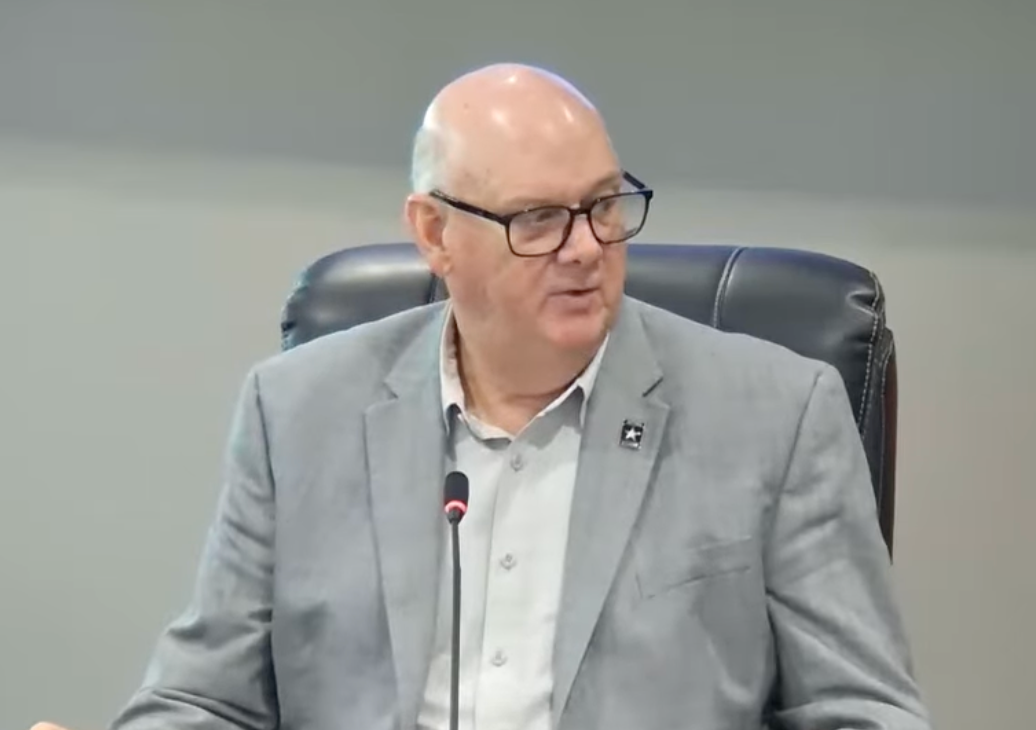
Magistrate Tom Botkin (Dist. 4) said he was offended by recent accusations that his support for a slew of recent zone change requests from area developers meant he was not heeding the wishes of his constituents. He said that magistrates represent the entire county, not only those who attend the Fiscal Court meetings.
“We represent 22,000 people. What about the rest of them people? Do they not get a say one way or another? Which ones are we not listening to?” said Botkin.
Ordinances
However, Botkin said that after walking the property at 200 Moran Mill Road, where a zone change was requested by Elk Garden, LLC, and its representatives, James Macklin Cox and members of the Epps family, he was persuaded by the geology of the farm to vote against rezoning it from agriculture to residential.
"While I believe that there’s places on this property that you could build homes, there’s also places where you could not build homes,” said Botkin.
In an interview with The Edge, Botkin said the property has too many gullies and ridges, thick with trees, to be fully developed. "There's some wilderness there," he said.
Billy Ray Hughes (Dist. 3), meanwhile, pointed to technicalities that he suggested should have disqualified the Moran Mill zone change request.
“There was a lot of correspondence on this particular land use change, and I know its technicalities are very important,” said Hughes. “Regulation says 14 days notification, but from the information we’re getting, is that 13 days was what was on the letters that were mailed out. So technically it wasn’t 14 days, the letter was dated July 8 and the meeting was on July 21.”
Planning and Zoning Director Bert Thomas interrupted Hughes. “That’s 14 calendar days. You got to count the day you got it, too, and the day of the hearing,” Thomas said, counting the days on his fingers.
Hughes said Thomas was using “interesting math”. Another issue with the application, according to Hughes, is that it was signed by an attorney and not by the actual property owner, making the application "a little bit questionable on a couple issues."
Hughes said he'd "lost confidence" in the County's planning and zoning process, given his fellow magistrates' reflexive support of developers. “I’m laying that out there for us common folks," Hughes said. "The cards seem to be stacked against the common people.”
Hughes noted the connection between how his fellow magistrates have consistently voted in favor of developers' requested zone changes, and how in response, constituents voted half of them out in May.
That's when Judge Executive Reagan Taylor lost by a 20% margin, Magistrate Stephen Lochmueller (Dist. 2) also lost, and Brian Combs (Dist. 1) kept his seat by just 17 votes. Botkin chose not to run again.
And the shift in seats might still not be over. Political newcomer Nick Marcum, whose cattle farm is close to the parcel at Moran Mill, has since decided to run against Combs as a write-in candidate.
The Moran Mill zone change passed 3 to 2, with Botkin and Hughes dissenting.
The Fiscal Court also passed Ordinance 2026-007, a zone change for 2775 Lancaster Road, moving it from agricultural to single-family residential for a subdivision. Hughes was the only no vote.
Ordinance 2026-008, changing the zoning on 215 Avawam Drive from a single-family residential to a multi-family residential for a 55 and older community, passed unanimously.
These were the last of six recent land use changes requested by local developers, who one local builder who did not wish to go on record, told The Edge, are "rushing through" their zone change requests before a less developer-friendly administration takes control of the Fiscal Court in January.
After the votes, citizens used the public comment section of the meeting to question how the zone changes align with the County’s comprehensive plan. Resident Julia Adams shared a devotional with the court and said that as a farmer she is trying to be a good steward of her property. Resident Mary McMahan asked about the status of the County’s comprehensive plan and Scott Mandl asked about negative effects of development from the land ordinance changes.
Taylor said that the public comments section was not for questions and that he would be happy to correspond about their concerns via email.
Resident Travis Barnes thanked Hughes and Botkin for their dissenting votes. He also said that County residents “don’t understand" the zone changes and that they would likely seek to have them repealed.
Area developer and land speculator, Patrick Sowers, owner of the former cattle farm at 2775 Lancaster Road, was the lone voice of support for the zone changes. He thanked the court for their vote and for their leadership, while also voicing his criticism for those who are “keyboard warriors that defame and slander” the court.
“We talk about preserving Madison County," Sowers said. "I’ve always had a for sale sign on everything I own. It’s pretty simple. If you want to preserve it, buy it.”
Resolutions
The Court also unanimously voted to approve Resolution 2026-076, empowering Taylor to apply for the Kentucky Association of Counties (KACo) insurance grant program which provides up to $10,000 for fiscal courts in reimbursement for products that reduce risk in any of the following categories: vehicle accidents, lifting and handling injuries, slip, trip and fall incidents, property damage, legal liability and personal safety.
The amount of funding will not be known until the grant awards are made. If awarded, the Madison County Fiscal Court will be required to contribute a 20% match for any grant awarded for reimbursement and future expenses. The Court unanimously approved with no discussion.
Next was unanimous approval of Resolution 2026-077, adopting Madison County’s 2026 property tax rates and 2027 motor vehicle and watercraft rates. The rate for real property was set at 0.063 per $100 of value, while the rate for tangible personal property and inventory was set at 0.0765 cents per $100. The motor vehicle and watercraft rate was set at 0.10 per $100.
Taylor noted that the real property rate had gone down from 0.065 from the last fiscal year. Botkin said this is the twelfth consecutive year the Fiscal Court has lowered the real property rate. Taylor said it was 0.083 when the two first were elected to the Fiscal Court in 2015.
The personal property rate increased over last year, from 0.075 cents in 2025 to 0.0765 cents per $100 this year.
Other business
Before the magistrate and public comment sections of the meeting, the Court adjourned for a 20-minute executive session to discuss an unspecified real estate transaction.
During the magistrate's comments, Hughes spoke out against his fellow magistrates' claims that by converting the 722 acre Carr farm into an industrial park, it will dramatically increase employment opportunities in the county.
“To think that you’re going to double the number of manufacturing jobs in one industrial site is absurd," Hughes said.
Speaking about the number of spaces intended for build-out at the Carr farm property, Hughes said, "I saw a sketch for 14 tracks. There are currently 102 establishments in Madison County, [averaging] about 40 employees. So if you took 14 [multiplied by] 40, actually five or 600 would be a realistic number of employees on this track, not a thousand.”
Previously, Hughes said that even if there were 1,000 employees earning an average of $75,000 a year, with annual payroll taxes at 1%, the County would only take in $750,000 annually, meaning it would take 109 years to pay off the property. The state has agreed to foot the $20 million necessary to purchase the farm for development into a regional business park.
Hughes cited how both Lochmueller and Combs have claimed in previous meetings that the industrial park could bring in as many as 3,000 jobs. Hughes pointed out that there are 3,900 manufacturing jobs countywide currently. Hughes said his math is based on 1,000 jobs.
Using the $20 million, plus an additional $63 million in estimated excavation costs, which equals $87,000 per acre, Hughes said he revised the hypothetical occupational tax collection numbers.
“Based on one thousand employees, instead of there being a 109 year payback it would be an 84 year pay back," he said. At between 500 and 600 jobs created, Hughes said the occupational tax revenues necessary to pay off the mortgage would take 157 years, not 109 years.
Hughes has consistently voted against purchasing the Carr farm for industrial purposes. In the last Fiscal Court meeting, Hughes was absent. That's when the Court voted to purchase the farm and turn it over to the Central Kentucky Business Park Authority, an interlocal industrial agency, in a 4 to 0 voice vote.
The Madison County Fiscal Court meets each second and fourth Tuesday at 9:30 a.m. The next scheduled meeting will take place at Berea's City Hall Annex. For more information, including links to the live-streamed meetings, visit the County’s website.
Whitney McKnight contributed to this report.
Sign up for The Edge, our free email newsletter.
Get the latest stories right in your inbox.