
Renewables keep BMU rates lower than state average
Plus, data centers aren't only driver of increased energy demands, all according to energy experts gathered for public forum
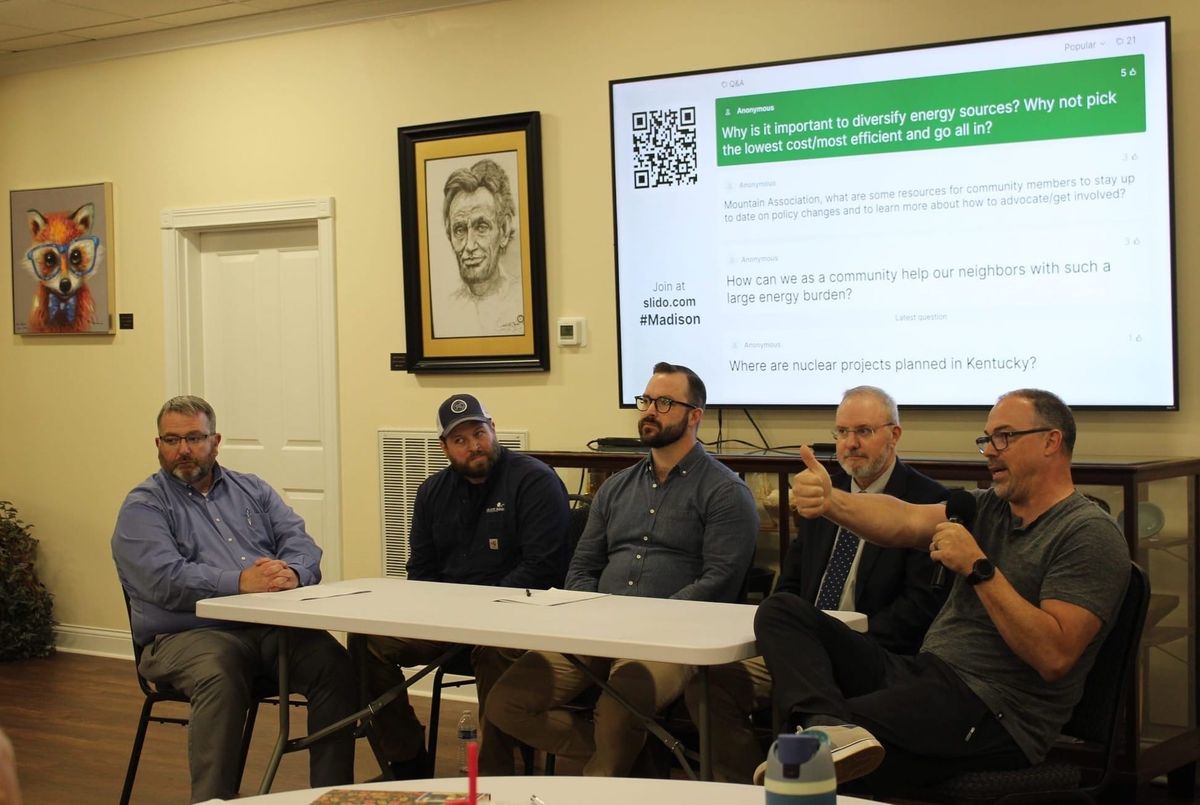
BEREA—Why power costs less here when compared with the rest of the state was just one of the energy-related topics ranging from electricity costs, renewable energy, to the potential for nuclear development in the state, explored in a recent forum held at the Berea Events Gallery.
The forum was a part of a public education series intended to give Kentuckians a better understanding of the state’s energy landscape and the decisions shaping its future. Bluegrass Greensource, an environmental education nonprofit, was the sponsor of the event.
Transition from coal
Although coal has long been Kentucky's leading energy source, other energy sources are on the rise in the state, Jenna Rector, the energy programs coordinator for Bluegrass Greensource, told the audience.
"Coal makes up just about 70% of our total electricity in the state. The other 22% is from natural gas, about 8% from hydro power, and then only about 0.4% is being contributed from solar," Rector said.
This can lead to lower rates for power customers, according to forum speaker, Kevin Howard, general manager of Berea Municipal Utilities.
Howard said that the Kentucky Municipal Energy Agency (KYMEA), which supplies power to more than 51,000 total customers across the state, including those with BMU, buys 100% of the power produced by Ashwood Solar, a 250 acre solar facility in Lyon County, Ky. The facility came online earlier this year, according to Howard.
The result is that on average, BMU customers pay just above 9 cents per kilowatt-hour, compared with the statewide average of 13.8 cents per kilowatt hour, according to Howard. However, Howard said that given current market forces, he anticipates BMU customers will see rates rise to between 9.5 and 9.6 cents in the next year.
KYMEA is also investing in a natural-gas power plant called Energy Center I, expected to be online late spring or summer 2027, Howard said.
“We hope those that come after us will look at this as a wise investment into the future. Again, it’s kind of a shift away from coal, it's having us find an alternative source to that. A reliable and a cost-effective alternative source to coal,” he said.
Data centers not only energy driver
The decision to shift away from coal is a statewide phenomenon, and that the surge in plans for hyperscale data center construction is not the only reason why, according to Nick Comer, spokesperson for East Kentucky Power Cooperative, and a presenter at the forum.
“Madison County is, I think, the fastest growing county in Kentucky,” said Comer. “Certainly you’re seeing a lot of new homes, a lot of shopping centers, office buildings, warehouses, factories, you name it, and that drives electricity growth.”
Comer said utilities have to plan years ahead. He said EKPC works with their 16 owner/member cooperatives to forecast what they predict will happen in the future, because power plants can take six or seven years, if not longer, to develop. Equipment, permits, supply chains and construction can all affect timelines, he said.
Comer also said the past few winter seasons have brought record or near-record power demands for EKPC. He said that Winter Storm Elliott and other cold-weather peaks showed how quickly the demand can exceed their expectations.
To meet the increased demand, Comer said the coop is building out new generation facilities, including a 745-megawatt natural gas combined cycle unit at the Cooper Station power plant in Somerset.
In Mason County, at Spurlock Station, EKPC's largest plant, the boilers are being converted to use natural gas, according to Comer, who said that a federal rule demanded that coal-fueled electric-generating units not converted to natural gas were to be decommissioned by 2032. The Spurlock plant features largely in the power needs anticipated for a 2.2 gigawatt hyperscale data center Meta plans to construct in Mason County.
EKPC also has two solar facilities under construction. Cooperative Solar Farm Two in Fayette County is 387 acres, capable of generating 40 megawatts. Cooperative Solar Farm Three in Marion County, north of Lebanon, is 635 acres, capable of generating 96 megawatts.
Reducing demand
Despite these advances in renewable energy sources, there is not enough reliance on community generated power, meaning Kentucky is one of 30 states to receive an F grade on energy generation from the Institute of Local Civil Reliance, according to Chris Woolery, residential energy coordinator at the Mountain Association.
During the forum, Woolery touted community distributed energy aggregation, which involves the collection and connection to the grid of unused power such as that stored in residential solar panels or home generators.
He said that a novel program coming to the area soon will allow more of this kind of creative energy aggregation to flourish.
“The least-cost option is one that transitions away from coal generation, and avoids new gas fired units, maintains reliability, keeps the existing access in place, but builds out renewables to bring in, and only calls in those older assets when it's necessary or cost effective,” said Woolery.
Ultimately, Kentucky should focus on reducing energy consumption altogether, according to Woolery.
Agrivoltaic, nuclear options
Solar energy development does not necessarily mean agricultural land has to stop being used for agriculture, according to Wade Archer, senior manager on Silicon Ranch’s Regenerative Energy Agribusiness Team, and a panelist at the forum.
"We own our land and we aim to leave it better (than before). Our slogan is, 'How do we make solar do more?'" said Archer. Silicon Ranch manages their solar farms with sheep grazing.
Archer said Silicon Ranch relies on 15 livestock farmers across five states to supply sheep, including at a solar facility south of Lancaster where farmer Daniel Bell, who uses his sheep herd to manage vegetation.
Archer claimed Silicon Ranch's solar farms can be decommissioned, leaving the land better than when it was first developed for solar generation. "You decommission all the equipment, and then farm it tomorrow," he said.
Aside from solar, Kentucky also has opportunities to participate in the nuclear industry through energy production, and the jobs and businesses that support it, according to Sean Schaub, who is the executive director of the Kentucky Nuclear Energy Development Authority.
Schaub said that nuclear energy can be produced with a small amount of material, giving it a much smaller land footprint. “When we think about meeting significantly larger energy needs in the future, this energy density becomes a very important characteristic,” he said.
Schaub said that nuclear plants routinely operate more than 90% of the time, meaning they can produce energy regardless of weather conditions. Many US reactors are now licensed for up to 80 years of operation, according to Schaub.
“The NRC [also] allows additional 20 year renewals subject to safety review as they go through that lifetime. And that means that a nuclear facility can support reliable generation and high quality employment across multiple generations, making really strong employers in the communities where they’re located,” said Schaub.
Schaub said the state is developing a voluntary program to help communities evaluate whether they may be prepared to consider nuclear development.
Sign up for The Edge, our free email newsletter.
Get the latest stories right in your inbox.