Hyperscale data centers signal the end of an era in policymaking
The new strategy begins with interrogating inherited narratives
DECATUR, Ala.—The late British rabbi and moral philosopher, Lord Johnathan Sacks, spoke often about how shared catastrophe unites previously divided communities.
We can see the truth of this observation in our national response to the sudden and rapid rise of resource hungry hyperscale data centers. Largely driven by the demands of artificial intelligence technology, these Goliaths not only threaten to exhaust our shared resources, but humanity's very existence, if we are to believe what AI's inventors tell us.
In the recent election, voters not only overcame decades of partisanship to force out mostly Conservative lawmakers who've done nothing to regulate AI and data center growth, but also to pass a staggering 40 out of 41 local ballot measures intended to reign in hyperscale data center development.
Twelve of those measures limit the size and scale of data center development while five ban them outright. Three created temporary moratoria. The other actions addressed zoning and some of the financial implications of these gargantuan developments.
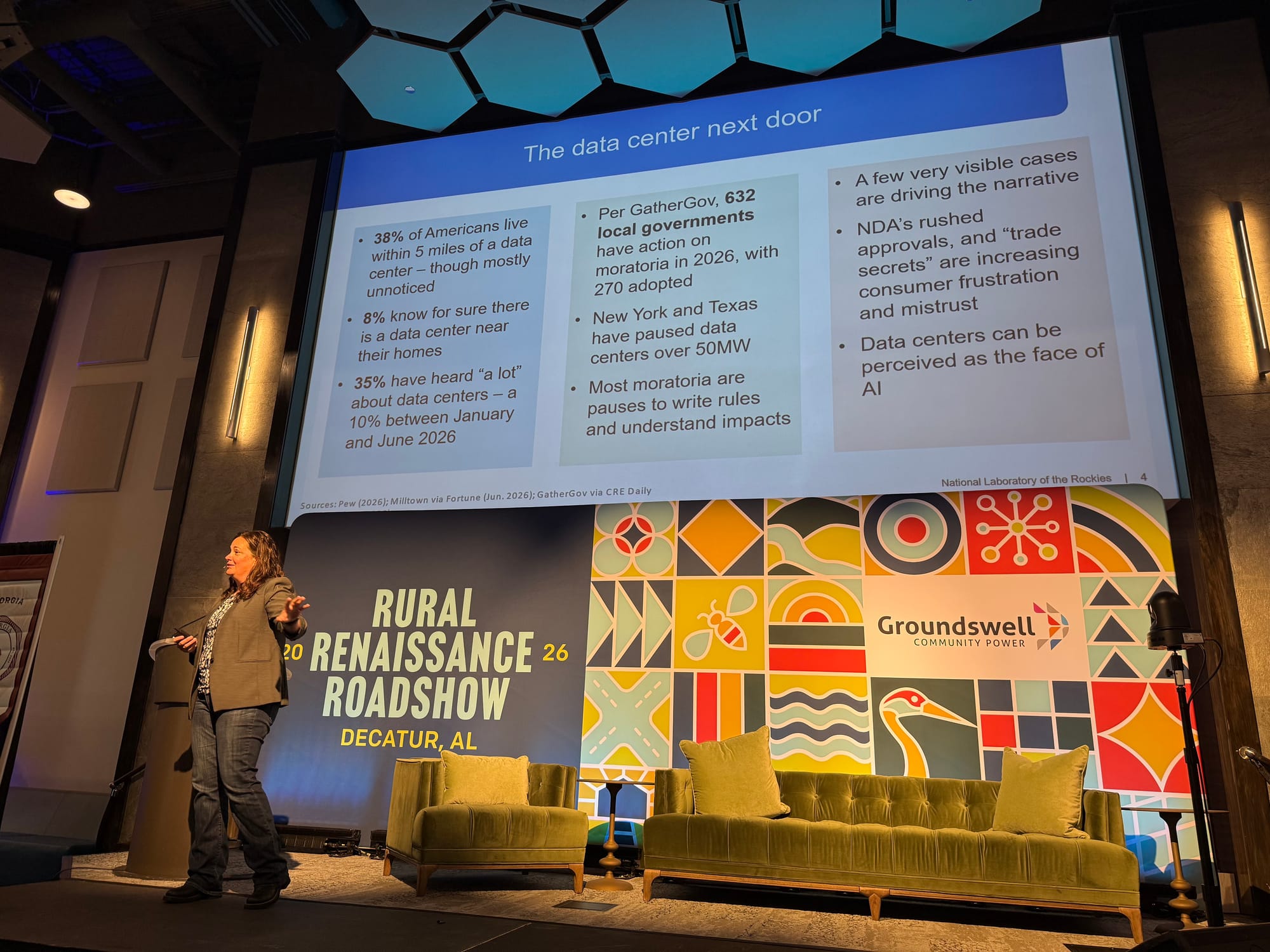
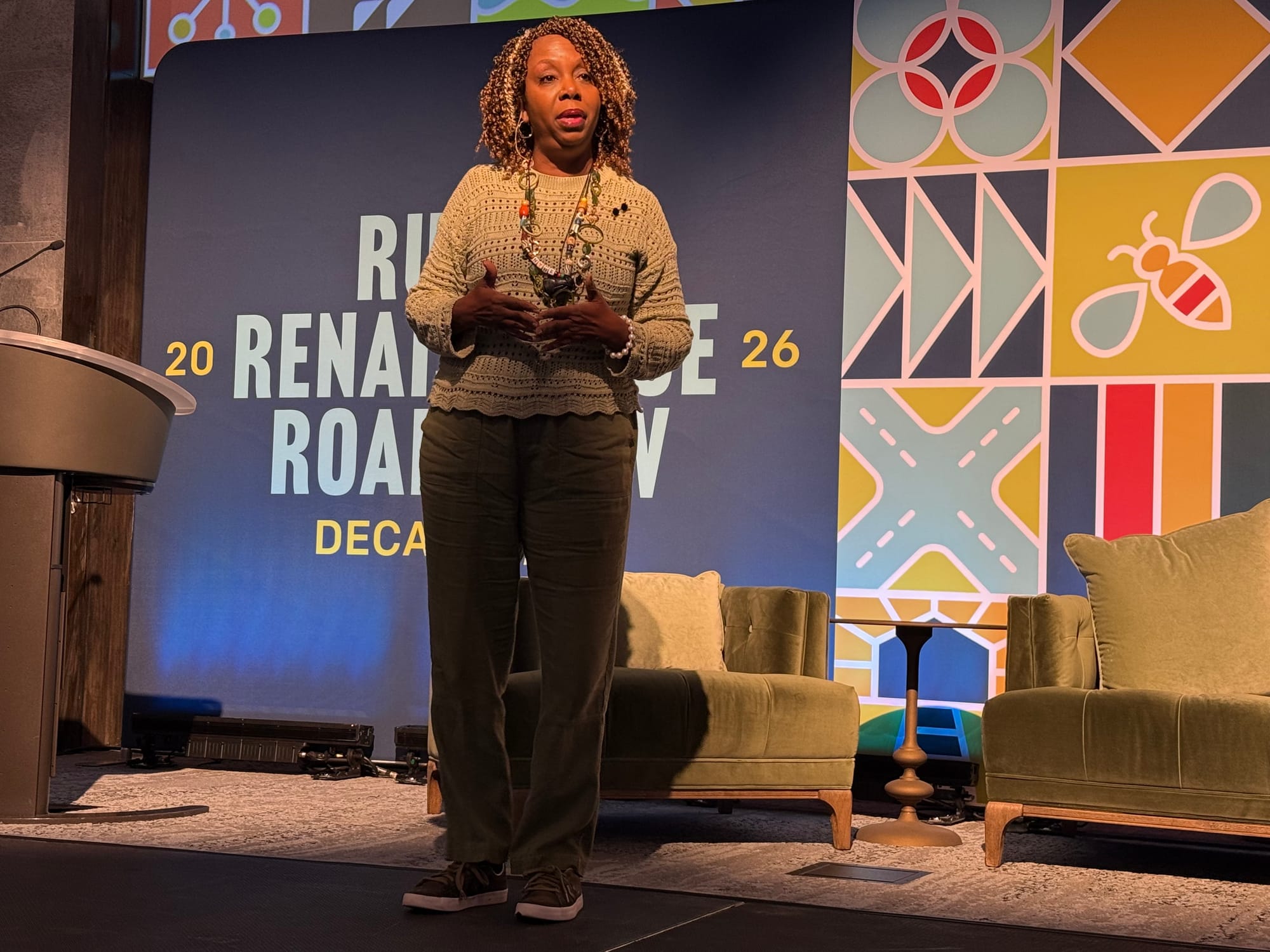
Meanwhile, at least 632 local governments have been grappling with what to do next, either because a demanding hyperscaler has arrived on their doorstep, or because they fear their community soon will face one, according to Sherry Stout, a policy analyst at the National Laboratory of the Rockies, a federal energy research lab.
"We're seeing moratoria, we're seeing people say we need to pause and figure out, 'What are these things? How are they affecting us? How do we need to go forward?'"
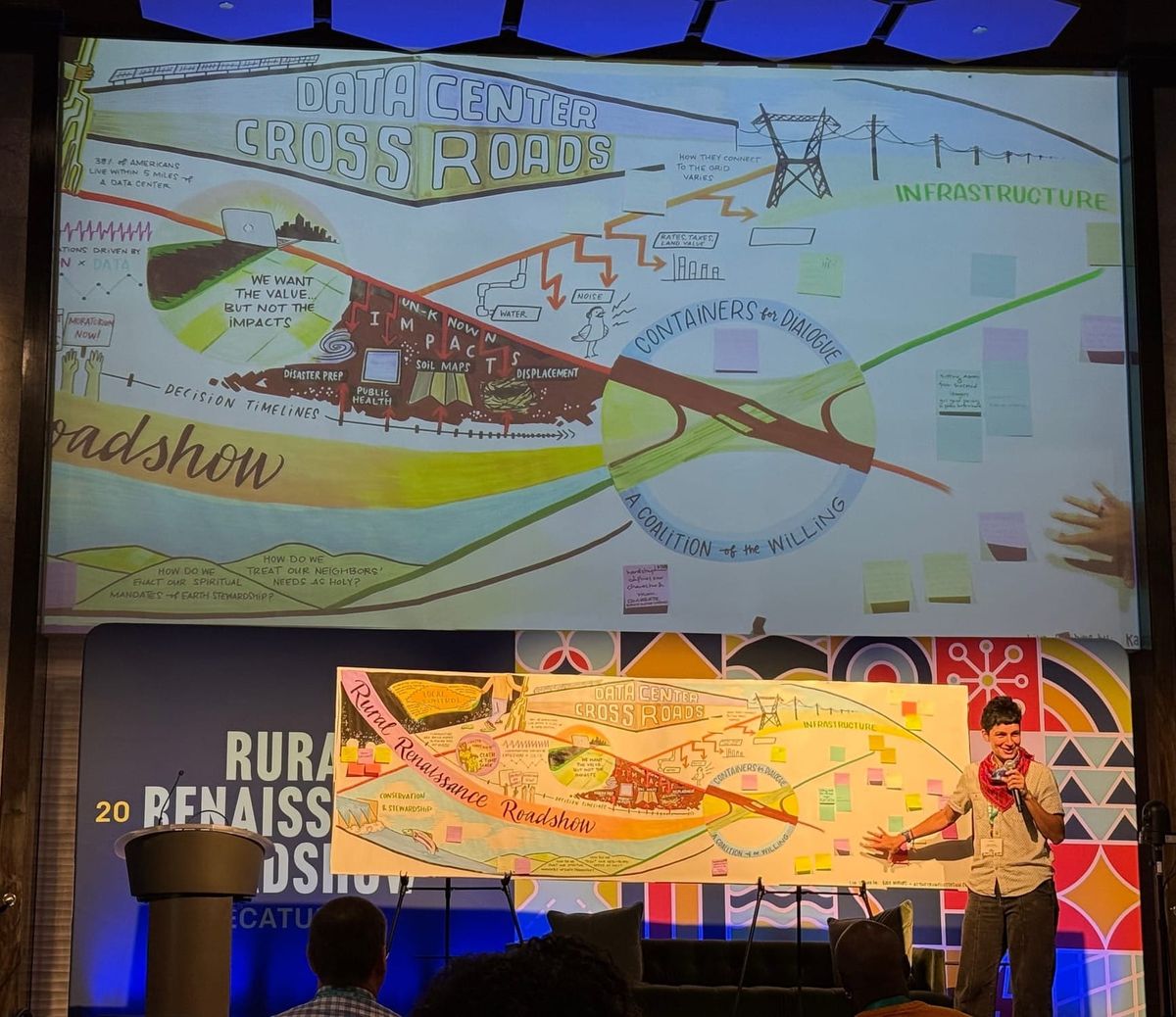
Stout made her comments during a keynote address at this year's Rural Renaissance Roadshow, hosted by Groundswell. The event's theme was: At the Data Center Crossroads.
But bans, moratoria, and even zoning regulations are merely stop gaps. If AI doesn't wipe us out first, the depletion of resources necessary to generate it inside these massive data centers certainly could.
We are indeed at a crossroads.
To avoid total catastrophe, the consensus at the Roadshow was that we must leverage this moment of unity to rethink policymaking at every level, possibly even reversing centuries of top-down templates for resource allocation altogether.
Policy hasn't kept up
Because the hyper-scale data center phenomenon came upon us so quickly, local governments have been caught flatfooted, without appropriate policies in place to address the strain on communities posed by these developments.
"Most zoning codes and local ordinances never envisioned a new type of energy- and water-hungry facility that is part warehouse, part computers, and part energy production facility," Ashely Wilmes, executive director of the Kentucky Resources Council, wrote in an email. Wilmes was to have been a speaker at the Roadshow, but was unable to attend, so she sent her comments to a reporter instead.
The result of this lack of preparation is that projects are imposed on communities, instead of integrated into them.
"Some communities are seeing projects that are moving forward without needing rezoning or a conditional use permit, leaving the community without much opportunity to require things like setbacks or noise restrictions," Wilmes wrote.
In Simpson County, Ky., which sits on the border with Tennessee, near the Nashville metro area where the data center industry has quickly spread north, plans are underway for a hyperscale data center project with on-site power generation.
Due to public opposition, this project is now tied up in court. Its developer, TenKey, LLC, is leveraging the local service establishments land use category to shoehorn its 220 acre campus into local zoning laws, a category which Wilmes emphasized "is meant to cover hair salons and laundromats!"
Disempowering local elected officials further have been the top-down actions of state legislative bodies based on an outdated economic growth paradigm that favors tax incentives to attract industries that are then regulated by existing local ordinances.
But in the age of the hyperscale data center, this thinking is not only outdated, it's regressive.
Since 2024, hyperscalers have descended upon Kentucky, where the General Assembly voted to lure hyperscalers with up to 50 years of tax exemptions on their equipment. The plan worked. By at least one count, there are now 31 data centers on the table in some local governments across the Commonwealth, most of them hyperscale.
But the plan also backfired.
"Most counties in Kentucky were not and are not prepared for the surge of hyperscale data center proposals following the massive tax breaks by our legislature that incentivized them," Wilmes wrote in the email.
Local leaders are the frontline
The hyperscaler surge has contributed to so much political upheaval that in Kentucky a record number of elected county officials were voted out of office this year across the primary and general election. The same occurred nationally where concerns over data centers have been cited as a contributing factor in the so-called Blue Wave that washed over the nation on Nov. 3.
Although Kentucky Governor Andy Beshear has since issued an executive order to address the overwhelm created by HB 775, and his economic development cabinet just this month outlined policy documents to guide the order, it is the state legislative body where the actual contours of policy are shaped and enforced.
In Washington, the White House is attempting to fit its own agenda onto state and local regulation of hyperscale data centers, claiming that national prosperity and security rests on the spread of these developments. To that end, Trump signed an executive order directing hyperscalers to be fast-tracked. The order also calls for loosening environmental regulations and building the centers on federal lands.
Congress meanwhile is struggling to catch up, having passed no meaningful legislation on the matter.
In sum, for the time being at least, the Roadshow evidenced how localities find themselves alone on the front lines of an intense battle for their natural resources.
Personal stories are data points
It's important for community leaders to realize that even with moratoria, these hyperscale developments are not going away. Already, according to Stout from the National Lab of the Rockies, more than a third of all persons in the US already live within five miles of a data center of all shapes and sizes.
Preparing for working with data center developers is essential. Ultimately, the goal is to craft a plan that is in place before data center developers arrive expecting to break ground, even if knowing where to begin planning is difficult.
Eventually, metrics such as the cost to support a hyperscaler's drain on the grid, the amount of water local aquifers can sustain siphoning for the data center, and other environmental and economic development concerns will need to be collected.
But several of the experts who spoke during the Roadshow agreed that the most important data points local officials must have are the views of the citizens who will be most impacted by large scale development. Their stories are what will help inform what gets measured and protected from large scale development.
One such constituency are farmers, according to Brady Peek, a third generation crop farmer in northern Alabama who spoke at the Roadshow about the future of agriculture in the era of hyperscalers.
Peek described how farmers like him are being priced out of being able to purchase farmland, leaving our nation's food supply in the hands of just a few global industrial agri-businesses. "It's a crisis brewing," he said.
Worse, according to Peek, is that when land is available, often, it does not have the best soil, or it is purchased by large-scale developers like solar farms and hyperscalers who then ruin the soil for future generations.
"I'm not against solar panels, but we have to recognize that with all land, we have to work together to know how to use it for whatever needs to be accomplished," Peek said.
He referenced the Hillsboro Solar 3 project now underway in Lawrence County, Ala. "That is some of the greatest soil on this earth. It hurts me as a farmer to drive through there and see that productive crop soil and know it's gonna have solar panels on it," Peek said. "Why can't we integrate solar panels on nonproductive land or on buildings or some other way?"
Although Peek sits on the Alabama Water Resources Commission, he says his and other farmers' views on soil have not been factored into the local equation on large scale developments, whether solar or hyperscale.
"Incomplete stories generate insufficient strategies," said Yinka Bode-George, recipient of one of this year's Rural Power Awards from Groundswell. Bode-George is the founder, president and CEO of the Sustain Our Future Foundation, which helps communities build benefit strategies when faced with large-scale renewable energy and sustainability infrastructure projects.
Transparency is essential
Whatever planning and zoning is put in place, it must stipulate transparency at all levels, according to several Roadshow speakers.
The lack of transparency around data center development was at issue for many voters in the recent election. Many were especially upset over nondisclosure agreements signed by elected officials put in office by voters who expected them to represent the community's interests, not the interests of outside developers.
"It used to be that in business NDAs would actually speed things along," said Stout. "Now, the second a community finds out their City Council has an NDA with a hyperscaler, that changes the conversation." NDAs contribute to people "freaking out" about AI and hyperscalers, Stout added.
For their part, hyperscaler Google says it will no longer demand NDAs when striking deals to build its hyperscale facilities, according to Kate Ottenweller, Google's lead for energy market development and policy in the Eastern US. Ottenweller, and a keynote speaker at the event.
"We're not using them anymore because of the responses communities have given," Ottenweller said. "Communities want to know what is happening and to weigh in on whether it is the right place for a data center."
Not all hyperscale developers have a listening ear, nor care to consider their impact on the local community, however.
In 2024, Elon Musk built his xAI Colossus, purportedly the world's largest supercomputer, in Memphis where at the time no zoning laws were in place.
"We've been accused of singing NDAs. I have not signed an NDA. Why? Because they didn't need us to," Pearl Eva Walker, Councilmember for Memphis's third District and a keynote speaker at the Roadshow.
Instead, Walker said the local Chamber of Commerce, not local elected officials, largely guided Musk's operation into place.
The little to no oversight of the operation has meant the Colossus facility currently is in violation of multiple environmental and other regulations, to the detriment of the local community, according to Walker. The Southern Environmental Law along with the NAACP have sued Musk and xAI on behalf of the Memphis community. A federal judge recently ruled the case can move forward, despite objections from the Trump administration.
Walker said her community is not opposed to data centers, as evidenced by residents' participation in meetings with other hyperscalers. But, she said, whenever Memphians hear Musk's name, "It's like throwing a brick into a pack of dogs."
She added that she and her fellow Councilmembers are now at work designing a community benefit agreement template that complies with a state law regulating how localities negotiate with hyperscalers.
Inherited narratives are obstacles
The Roadshow was a gathering of diverse community leaders and advocates primarily from across the rural South, gathered not only to discuss how to regulate data center development when so few data on best practices exist, but also to engage in fellowship.
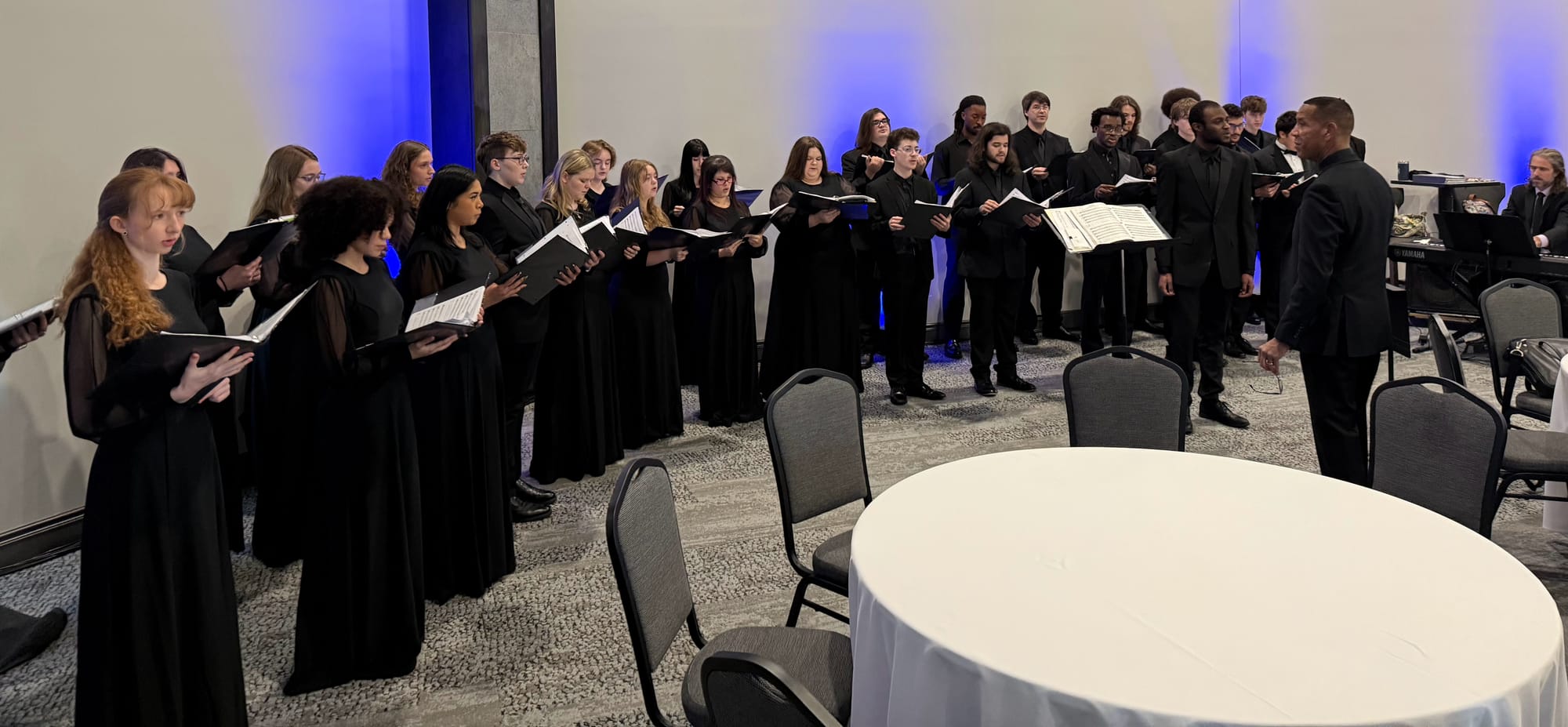
Interspersed between the panels and keynotes were prayers, indigenous singing, a gospel choir, and other musical acts. There were optional field trips to a local farm and cotton gin, solar facilities, and even to a stop on the Trail of Tears, among other selected activities.
These were followed by a final convening where attendees and speakers were invited to share insights gleaned from the event. Reflections about any top-down approach to policymaking, whether it be organized through a Capitalist, Communist, or Socialist framework, made clear that when stories of how everyone relies on the landscape are not considered, there will be neither peace nor prosperity.
Policymaking that relies on private property rights and secrecy to foster growth at any cost and wealth concentration for a few can no longer be sustained, and has in fact become catastrophic, several speakers and attendees agreed.
"Ego and false narratives are the true obstacle," said Bode-George.
In the aggregate, the takeaway was that the reason humanity finds itself facing this existential crisis is because the top-down paradigm we have all lived under for centuries is ending, whether or not our elected officials either realize or accept it.
Local communities realize it, however, and are coming together to create a sustainable, inclusive paradigm that emanates from locally shared values based in how communities actually live on the land. The demand for leadership that accepts and complies with this perspective has only just begun.
Sign up for The Edge, our free email newsletter.
Get the latest stories right in your inbox.